
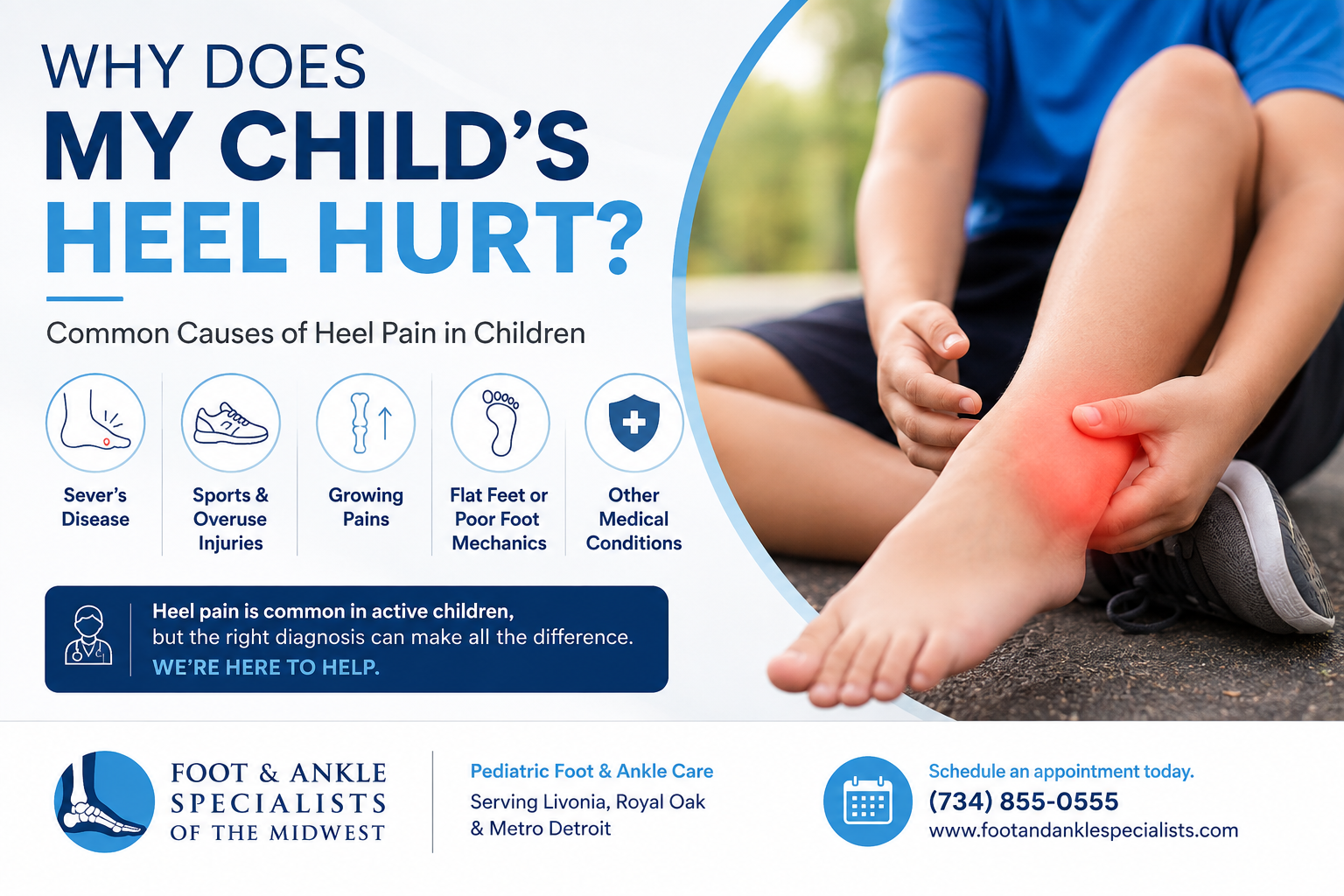

Why Does My Child’s Heel Hurt?
When a child starts complaining about heel pain, parents often wonder whether it is simply soreness from sports, a normal part of growing, or something that needs professional attention. Heel pain in children is common, especially in active kids and young athletes, but recurring pain should not automatically be dismissed as “growing pains.”
Children’s feet are still developing. Their bones, growth plates, muscles, tendons, and walking mechanics continue changing throughout childhood and adolescence. Because of this, pediatric heel pain often has different causes than heel pain in adults. Conditions such as Sever’s disease, growth plate irritation, overuse injuries, tight calf muscles, sports-related stress, and changes in foot mechanics are all possible reasons a child may begin experiencing pain around the heel.
Some children first notice pain after soccer practice, basketball, gymnastics, track, dance, or another high-impact activity. Others may begin limping at the end of the day, complain that the heel hurts when they first stand up, or avoid running because the pain keeps returning. The location, timing, and pattern of the symptoms can provide important clues about what is causing the problem.
At Nationwide Foot & Ankle Care, P.C., we evaluate pediatric heel pain for families throughout Livonia, Royal Oak, Metro Detroit, and Southeast Michigan. Our goal is to determine whether your child is experiencing a temporary developmental issue, a sports-related overuse injury, Sever’s disease, or another condition that may benefit from treatment.
Is Heel Pain Normal in Children?
Occasional soreness after an unusually active day can happen in children just as it can in adults. A long soccer tournament, a day at an amusement park, or a sudden increase in running may temporarily leave the feet and legs tired. Mild soreness that improves quickly with rest is usually less concerning.
Recurring or persistent heel pain is different. A healthy child should generally be able to walk, run, jump, participate in sports, and play without repeatedly developing pain in the same location. If the heel hurts after every practice, causes limping, changes the way your child walks, or begins limiting normal activity, the symptoms deserve a closer look.
One important difference between children and adults is the presence of active growth plates. Growth plates are areas of developing tissue near the ends of certain bones. They allow bones to lengthen as a child grows, but they can also become irritated by repeated stress. The growth plate at the back of the heel is especially vulnerable during periods of rapid growth and athletic activity.
This is one reason heel pain in children commonly appears during late elementary school and early adolescence, when growth spurts and sports participation often overlap.
The Most Common Cause of Heel Pain in Children: Sever’s Disease
The most common cause of heel pain in active children is Sever’s disease, also known as calcaneal apophysitis. Despite the name, Sever’s disease is not an infection and is not a disease in the traditional sense. It is an overuse-related irritation of the growth plate at the back of the heel bone.
The heel bone, or calcaneus, continues developing throughout childhood. Near the back of the heel is a growth plate where the Achilles tendon attaches. During a growth spurt, the heel bone may lengthen more quickly than the surrounding muscles and tendons can adapt. This can increase tension from the Achilles tendon and place repeated pulling forces on the developing heel.
When running, jumping, sprinting, or changing direction repeatedly, the heel absorbs significant impact while the Achilles tendon continues pulling on the growth plate. Over time, this combination can irritate the area and produce the pain associated with Sever’s disease.
Children with Sever’s disease may complain of pain at the back or bottom of the heel, particularly during sports or immediately afterward. Symptoms may affect one heel or both heels and often improve during periods of rest before returning once activity resumes.
What Age Does Sever’s Disease Usually Occur?
Sever’s disease most commonly affects school-aged children and young adolescents whose heel growth plates are still open. It often appears during the years when children are growing rapidly and becoming more involved in organized sports.
Parents often first notice symptoms between roughly ages 8 and 14, although the exact timing varies based on the child’s development. Once the growth plate has matured and closed, Sever’s disease is no longer a cause of heel pain.
The condition may flare during a growth spurt and then improve, only to return when sports intensity increases. This pattern can be frustrating because a child may seem fully recovered during a quieter period and then develop pain again when practices, tournaments, or conditioning resume.
What Does Sever’s Disease Feel Like?
Children often describe the discomfort as soreness, aching, tenderness, or a bruised feeling around the heel. Some may have difficulty explaining the pain precisely and simply say their “foot hurts.”
Common patterns include:
- Pain at the back or bottom of the heel
- Heel pain during or after running
- Pain after soccer, basketball, gymnastics, dance, track, or other sports
- Limping after practice or games
- Walking on the toes to avoid heel pressure
- Tenderness when the sides of the heel are squeezed
- Symptoms that improve with rest and return with activity
- Pain affecting one or both heels
Children may continue participating in sports despite these symptoms, especially if they are worried about missing games or disappointing teammates. Parents should pay attention when a child begins changing the way they run, avoids putting the heel on the ground, or becomes reluctant to participate in activities that were previously comfortable.
Why Does My Child’s Heel Hurt After Sports?
Child heel pain after sports is especially common because running and jumping repeatedly load the heel and Achilles tendon. Sports involving sprinting, cutting, jumping, or frequent changes in direction can place thousands of repetitive forces through the feet during a single week of practices and games.
A child may feel fine before practice and begin developing pain halfway through the session. Others may complete the entire game but limp afterward or complain about pain once they get home. Symptoms can also be worse the morning after a tournament or during the first few steps after sitting for an extended period.
The problem may become more noticeable when training volume increases suddenly. Moving from a recreational schedule to multiple practices each week, starting a new season, attending sports camps, joining travel teams, or playing several sports at once can dramatically increase the amount of stress placed on growing feet.
Growth spurts can make this even more noticeable. As bones lengthen, the calf muscles and Achilles tendon may temporarily become relatively tight. That increased tension can place additional pulling stress around the heel and make running or jumping uncomfortable.
Sports Commonly Associated With Pediatric Heel Pain
Any activity involving repeated impact can aggravate heel pain, but certain sports place especially high demands on the heel and Achilles tendon.
- Soccer
- Basketball
- Football
- Track and field
- Cross-country
- Volleyball
- Gymnastics
- Dance
- Cheerleading
- Tennis
- Lacrosse
- Baseball and softball
This does not mean children should avoid these activities. Sports provide important physical, social, and emotional benefits. The goal is to recognize symptoms early and adjust training when necessary rather than allowing repeated pain to become more severe.
Is Heel Pain Just Growing Pains?
Parents are frequently told that leg or foot discomfort is simply a normal part of growing. True growing pains do occur, but they generally have a different pattern from localized heel pain caused by an overuse injury or growth plate irritation.
Growing pains more commonly affect both legs and are often described as aching in the calves, thighs, or behind the knees. They tend to occur in the evening or at night and usually do not cause persistent tenderness in one specific location.
By contrast, pediatric heel pain that consistently appears during sports, hurts when the heel is pressed, causes limping, or worsens with running is more likely to involve a local foot or ankle condition.
Parents should be cautious about using “growing pains” as an explanation for recurring pain that affects activity. Growth may contribute to the underlying problem, but that does not mean the symptoms should simply be ignored.
Why Growth Spurts Can Trigger Heel Pain
Growth does not occur evenly throughout the entire body. During certain stages of childhood and adolescence, bones may lengthen quickly while the surrounding muscles and tendons take time to adapt.
The calf muscles and Achilles tendon are especially important because they attach near the back of the heel. When these structures become relatively tight during a growth spurt, the tension placed on the heel can increase.
Now add repetitive sports activity to that tightness. Every sprint, jump, landing, and push-off creates additional force through the heel. This combination of rapid skeletal growth and high activity is one reason Sever’s disease is so common among young athletes.
Some children may also appear temporarily less coordinated during growth spurts. Changes in leg length, body proportions, strength, and flexibility can alter running mechanics and place stress on areas that previously tolerated activity without difficulty.
Other Causes of Heel Pain in Children
Although Sever’s disease is one of the most common causes of heel pain in active children, it is not the only possibility. Several other conditions can produce pain around the heel, which is why persistent symptoms should be evaluated rather than diagnosed based only on age or sports participation.
Achilles Tendon Irritation
The Achilles tendon can become irritated from repetitive activity, sudden increases in training, tight calf muscles, or changes in biomechanics. Children may experience pain or tenderness behind the ankle or near the point where the tendon approaches the heel.
Achilles-related pain may resemble Sever’s disease because both conditions occur near the back of the heel. The age of the child, location of tenderness, flexibility, and examination findings help determine which structure is causing the symptoms.
Plantar Fascia Irritation
The plantar fascia is a strong band of connective tissue running along the bottom of the foot from the heel toward the toes. Although plantar fasciitis is much more common in adults, older children and teenagers can occasionally develop irritation in this region, especially when activity levels, foot mechanics, or muscle tightness contribute to increased strain.
Heel Bone Stress Injuries
Repetitive impact can occasionally lead to a stress reaction or stress fracture in the heel bone. These injuries may develop gradually rather than after one dramatic event and can become more painful as activity continues.
Unlike typical Sever’s disease, a stress injury may cause more consistent pain with weight-bearing and may not improve as quickly with short periods of rest. Imaging may be recommended when a bone injury is suspected.
Heel Bruises and Direct Trauma
A direct fall onto the heel, repeated jumping on a hard surface, or being stepped on during sports can bruise the soft tissue beneath the heel. Children may experience tenderness when standing or walking directly on the affected area.
Flat Feet and Foot Mechanics
Flat feet do not automatically cause heel pain, and many children with flexible flat feet remain completely comfortable. However, when low arches are associated with excessive strain, tightness, or abnormal mechanics, they may contribute to discomfort around the heel or Achilles tendon in some children.
This is especially relevant when heel pain occurs alongside foot fatigue, recurring ankle problems, or difficulty keeping up during sports.
Tarsal Coalition
Tarsal coalition is an abnormal connection between two or more bones in the foot. It may not cause noticeable symptoms during early childhood, but as the bones mature, some children develop stiffness, recurring ankle sprains, flat-foot appearance, and pain around the rearfoot or heel.
A child with a very stiff foot, recurring pain, or limited side-to-side motion may need additional imaging to determine whether an underlying structural condition is present.
Inflammatory or Systemic Conditions
Heel pain is usually related to local overuse or growth, but less common medical conditions can also affect children’s feet. Inflammatory arthritis, infections, and other systemic conditions may produce heel pain along with swelling, redness, stiffness, fever, or symptoms elsewhere in the body.
Heel pain accompanied by significant swelling, warmth, fever, unusual fatigue, or symptoms that occur even at rest should be evaluated promptly.
Signs Your Child’s Heel Pain Needs a Closer Look
Children do not always explain pain clearly. Some can point directly to the heel and describe when it hurts, while others may simply slow down, stop running, ask to be carried, or lose interest in activities they normally enjoy. These changes in behavior can be just as important as the pain itself.
Parents should pay attention to patterns. Heel pain in children that appears after every practice, worsens during sports, causes limping, or repeatedly returns after rest may indicate more than simple muscle fatigue.
Warning signs that deserve evaluation include:
- Heel pain lasting more than several days
- Pain that returns every time your child runs or plays sports
- Limping during or after activity
- Walking on the toes to avoid heel pressure
- Pain severe enough to stop sports or playground activity
- Tenderness when the heel is touched or squeezed
- Swelling, redness, or warmth around the heel
- Difficulty putting weight on the foot
- Pain that occurs at rest or wakes your child at night
- Recurring pain affecting only one heel
- Pain following a fall, collision, or direct injury
Most pediatric heel pain is not dangerous, but a professional evaluation helps determine whether the symptoms are related to growth, sports overuse, Sever’s disease, a tendon problem, a bone injury, or another condition requiring a different treatment approach.
How Pediatric Heel Pain Is Diagnosed
Diagnosing pediatric heel pain starts with understanding when the symptoms began, what activities make them worse, and whether your child has recently experienced a growth spurt, sports injury, or major change in activity level.
Your podiatrist may ask whether the pain occurs in one heel or both, whether it is worse during sports, whether your child limps afterward, and whether rest improves the symptoms. Shoes, training schedules, previous injuries, medical history, and family foot structure may also provide useful information.
Physical Examination
During the physical examination, the podiatrist evaluates the heel, Achilles tendon, foot structure, ankles, calves, and surrounding joints. Areas of tenderness are identified and compared between both sides.
The examination may include checking:
- Heel tenderness
- Achilles tendon flexibility
- Calf muscle tightness
- Foot and ankle range of motion
- Flat feet or high arches
- Foot and leg alignment
- Balance and strength
- Swelling or bruising
- Areas of pain during weight-bearing
In suspected Sever’s disease, tenderness around the heel growth plate and pain associated with activity are important findings. Your podiatrist also looks for clues that suggest a fracture, tendon injury, structural condition, or another cause of heel pain.
Walking and Gait Evaluation
Watching your child walk can reveal movement patterns that are not obvious while sitting on an examination table. The podiatrist may evaluate whether the feet turn inward or outward, whether the arches collapse, how the heels move, and whether your child avoids pressure on the painful side.
For young athletes, running mechanics can be especially useful. A child may compensate for heel pain by shortening their stride, landing differently, or shifting weight toward the opposite foot. These adjustments may help explain why pain persists or why other areas begin to feel sore.
Are X-Rays Needed for Heel Pain in Children?
Not every child with heel pain needs an X-ray. Many cases of Sever’s disease can be identified based on age, symptoms, activity pattern, and physical examination.
X-rays may be recommended when the pain is severe, follows a traumatic injury, affects only one side in an unusual pattern, does not improve as expected, or when the examination raises concern for a fracture, bone abnormality, or another condition.
Additional imaging may occasionally be appropriate when a stress injury, tendon problem, tarsal coalition, infection, or another less common cause is suspected.
Treatment for Heel Pain in Children
Treatment depends on the diagnosis, severity of symptoms, age of the child, activity level, and whether the pain is interfering with walking, school, or sports. Fortunately, most causes of heel pain in children can be treated without surgery.
For Sever’s disease and many overuse-related conditions, the goal is to reduce stress on the irritated heel while maintaining enough flexibility, strength, and support for the child to return safely to activity.
Activity Modification
One of the most effective first steps is temporarily reducing activities that repeatedly trigger the pain. This does not always mean complete inactivity.
A child may be able to participate in lower-impact conditioning, swimming, cycling, or modified practice while reducing running and jumping. The exact level of activity should be based on symptoms and the underlying diagnosis.
If your child is limping or changing the way they run because of pain, continuing full sports participation is usually not a good idea. Playing through significant pain can prolong irritation and create compensatory movement patterns.
Ice After Activity
Cold therapy may help reduce soreness after sports or periods of increased activity. Ice should be wrapped in a thin towel rather than placed directly against the skin.
Parents should follow the treatment recommendations provided for their child rather than relying on ice alone if pain continues returning.
Calf and Achilles Stretching
Tight calf muscles and Achilles tendons can increase pulling stress around the developing heel. Stretching may be especially helpful during growth spurts when flexibility temporarily decreases.
A stretching program may include gentle calf stretches with the knee straight and bent to address different muscle groups. The exercises should feel like a mild stretch rather than sharp pain.
Consistency matters. Stretching only once after pain becomes severe is less useful than maintaining flexibility throughout a sports season.
Supportive Shoes
Children with heel pain often benefit from athletic shoes that provide adequate cushioning and fit properly. Shoes that are excessively worn, too small, too flexible, or poorly matched to the sport can increase discomfort.
Because children’s feet grow quickly, shoe size should be checked regularly. A shoe that fit comfortably at the beginning of a season may become too tight only a few months later.
Parents should also look at the condition of the shoe rather than age alone. Compressed midsoles, uneven wear, damaged heel counters, and worn tread can reduce support even when the shoe still looks acceptable from the outside.
Heel Cups and Cushioned Inserts
Heel cups or cushioned inserts may help reduce impact and provide additional comfort during walking and sports. They can be particularly useful when symptoms are related to repeated loading of the heel.
The best option depends on the child’s foot structure, shoes, and activity. An insert should fit comfortably inside the shoe without crowding the toes or changing the fit significantly.
Custom Orthotics
Not every child with heel pain needs custom orthotics. However, they may be considered when foot mechanics, flat feet, recurring injuries, or persistent symptoms contribute to abnormal stress around the heel.
Custom orthotics are designed to support the foot and redistribute pressure based on the child’s individual mechanics. Their purpose is not simply to “build an arch,” but to improve comfort and function when a specific biomechanical issue is contributing to symptoms.
Physical Therapy
Physical therapy may be recommended when heel pain is associated with significant muscle tightness, weakness, poor balance, abnormal running mechanics, or recurring sports injuries.
Therapy can address more than the painful heel. Exercises may focus on calf flexibility, ankle strength, hip strength, balance, landing mechanics, and sport-specific movement patterns that influence stress throughout the lower body.
Temporary Immobilization for Severe Pain
Most children with Sever’s disease do not need a walking boot. However, temporary immobilization may be considered when pain is severe, walking is difficult, or symptoms are not improving with more basic treatment.
Immobilization reduces repeated stress on the painful area and allows irritated tissues time to settle. Your podiatrist will determine whether this is appropriate based on the severity of the symptoms.
Pain Medication
Over-the-counter pain or anti-inflammatory medication may be appropriate for some children, but parents should use medication only according to the child’s age, health history, product instructions, and guidance from an appropriate healthcare professional.
Medication should not be used simply to allow a child to continue playing through an injury that is causing significant pain.

How Long Does Sever’s Disease Last?
One of the most common questions parents ask is how long heel pain from Sever’s disease will last. The answer varies because symptoms are influenced by growth, activity level, flexibility, sports schedule, and how quickly treatment begins.
Some children improve within a few weeks after reducing aggravating activity and following a consistent stretching and support program. Others experience flare-ups that come and go throughout a growth period, particularly when sports intensity increases.
Sever’s disease is self-limited because the heel growth plate eventually matures. Once that growth plate closes, calcaneal apophysitis is no longer a cause of heel pain.
That does not mean children should simply tolerate pain until they finish growing. Symptoms can often be managed effectively so that the child remains comfortable and active during development.
Can Sever’s Disease Cause Permanent Damage?
Sever’s disease does not usually cause permanent damage to the heel growth plate. It is an irritation associated with growth and repetitive stress rather than a destructive condition.
The larger concern is how pain affects your child in the short term. A child who continues running while limping may change movement patterns, lose flexibility, or begin placing additional stress on the opposite leg and other joints.
Managing symptoms early can help reduce unnecessary discomfort and allow for a safer return to normal activity.
Can My Child Play Sports With Sever’s Disease?
Some children with mild symptoms can remain active with treatment and appropriate modifications. Others need a temporary break from running and jumping until pain decreases.
The most important factor is function. A child should not be encouraged to play through pain that causes limping or significantly changes movement.
A practical way to judge activity tolerance is to look at what happens during and after sports. If your child can participate comfortably and remains pain-free afterward, the activity may be acceptable. If pain steadily increases, causes limping, or remains significantly worse the next day, the current level of activity may be too high.
Young athletes often need help making this decision because they may minimize symptoms to stay on the field. Parents, coaches, therapists, and podiatrists can work together to find a balance between recovery and maintaining appropriate conditioning.
When Can My Child Return to Sports?
Returning to sports should be based on function rather than a specific number of days. The amount of time away from full activity varies depending on the diagnosis and severity of symptoms.
Before returning fully, your child should generally be able to:
- Walk without limping
- Run without significant heel pain
- Jump comfortably
- Move the ankle through a functional range of motion
- Complete sport-specific movements without compensating
- Participate without symptoms becoming significantly worse afterward
Returning gradually is often better than going directly from complete rest to a full tournament weekend. Practices, conditioning, and game time may be increased step by step as symptoms allow.
How to Help Prevent Heel Pain in Young Athletes
Not every case of pediatric heel pain can be prevented. Growth itself is not something parents can control, and active children will always experience some bumps and soreness. However, several habits may help reduce excessive stress on developing feet.
Increase Training Gradually
Sudden increases in running distance, practice frequency, tournament volume, or conditioning intensity can overload tissues that have not had time to adapt.
Whenever possible, training should increase gradually rather than doubling overnight because a new season begins.
Maintain Flexibility
Regular calf and Achilles stretching may help children maintain flexibility during growth spurts. Flexibility becomes especially important when sports involve repeated sprinting, jumping, or cutting.
Use Appropriate Athletic Shoes
Shoes should fit the child’s current foot size and match the activity being performed. Running shoes, basketball shoes, soccer cleats, and dance footwear are designed for different movement demands.
A child should not continue wearing shoes that are too small simply because they have not visibly worn out.
Replace Worn Shoes
Athletic footwear loses cushioning and structure with use. Children involved in frequent practices may wear through shoes much faster than parents expect.
Check for excessive tread wear, uneven compression, collapsed midsoles, and damaged heel counters.
Allow Recovery Time
Children who participate in organized sports year-round may have very little opportunity for recovery. Multiple teams, overlapping seasons, and weekend tournaments can create a training load that resembles adult athletics while the body is still growing.
Rest days and periods of lower-impact activity can help reduce repetitive stress.
Do Not Ignore Recurring Pain
Early heel pain is often easier to manage than symptoms that have been present for months. Encourage children to tell parents and coaches when something hurts rather than hiding pain to avoid missing a game.
Choosing Shoes for a Child With Heel Pain
Shoes alone do not treat every cause of heel pain, but poor-fitting or worn footwear can aggravate an already irritated heel.
Look for shoes that:
- Fit properly in both length and width
- Provide adequate cushioning under the heel
- Hold the heel securely
- Do not rub against the painful area
- Are appropriate for the child’s sport
- Have not lost their cushioning or structural support
If your child uses cleats, skates, dance shoes, or other specialized footwear, bring them to the appointment when possible. These shoes can provide useful clues about pressure points and fit.
Common Myths About Heel Pain in Children
Myth: Heel Pain Is Always Just Growing Pains
Growth can contribute to heel pain, but localized pain that repeatedly occurs during sports may represent Sever’s disease or another foot and ankle condition. Persistent pain should not be dismissed simply because a child is growing.
Myth: My Child Has to Stop Sports Completely
Not necessarily. Some children can continue selected activities with modifications, while others need a temporary reduction in impact. The appropriate recommendation depends on pain severity and diagnosis.
Myth: Sever’s Disease Causes Permanent Heel Damage
Sever’s disease is generally temporary and resolves when the heel growth plate matures. Treatment focuses on controlling symptoms and maintaining healthy movement during the growth period.
Myth: Only Competitive Athletes Develop Heel Pain
Competitive athletes are at higher risk because of repeated impact, but any active child can develop heel pain. Playground activity, recreational running, dance, physical education, and sudden increases in exercise can also trigger symptoms.
Myth: If My Child Can Still Play, the Heel Is Fine
Children sometimes continue playing despite significant pain. Look for limping, toe walking, reduced speed, shorter strides, or complaints after activity rather than relying only on whether your child stays in the game.
When Should My Child See a Podiatrist for Heel Pain?
Parents do not need to wait until heel pain becomes severe. An evaluation can often determine whether symptoms are part of a common growth-related condition or whether another injury needs treatment.
Consider scheduling a pediatric foot evaluation if your child:
- Has heel pain that repeatedly returns
- Limps after sports or activity
- Walks on the toes to avoid heel pressure
- Stops participating in activities because of pain
- Has pain in the same location for more than several days
- Experiences pain with normal walking
- Has swelling, bruising, redness, or warmth
- Cannot comfortably bear weight
- Has symptoms after a fall or traumatic injury
- Has heel pain that is getting worse despite rest
A pediatric podiatrist can help distinguish between Sever’s disease, tendon problems, stress injuries, foot mechanics, and other possible causes of heel pain in children.

Pediatric Heel Pain Treatment in Metro Detroit
At Nationwide Foot & Ankle Care, P.C., we provide pediatric foot and ankle evaluations for children experiencing heel pain, Sever’s disease, sports injuries, flat feet, walking abnormalities, recurring ankle injuries, and other conditions affecting growing feet.
Our goal is to determine what is causing your child’s pain and recommend treatment that supports comfort, healthy development, and a safe return to normal activity.
We proudly care for families throughout Livonia, Royal Oak, Detroit, Southfield, Dearborn, Dearborn Heights, Westland, Plymouth, Northville, Farmington Hills, Novi, Birmingham, West Bloomfield, Troy, Auburn Hills, Clawson, Commerce Township, and surrounding Southeast Michigan communities.
If your child repeatedly complains that their heel hurts after soccer, basketball, running, dance, gymnastics, or everyday activity, you do not have to guess whether it is normal. A comprehensive pediatric foot evaluation can provide answers and help determine the most appropriate next step.
Schedule a Pediatric Heel Pain Evaluation
If heel pain is causing your child to limp, avoid sports, or repeatedly complain after activity, schedule an evaluation with Nationwide Foot & Ankle Care, P.C.
Our podiatrists provide pediatric foot and ankle care for families throughout Livonia, Royal Oak, Metro Detroit, and Southeast Michigan.
Frequently Asked Questions About Heel Pain in Children
What is the most common cause of heel pain in children?
One of the most common causes is Sever’s disease, also called calcaneal apophysitis. It is an irritation of the heel growth plate that often affects active children during periods of rapid growth.
At what age does Sever’s disease occur?
Sever’s disease commonly occurs in school-aged children and young adolescents while the heel growth plate remains open, often around ages 8 to 14. Timing varies based on individual growth and development.
Why does my child’s heel hurt after soccer or basketball?
Running, jumping, cutting, and repeated impact can place stress on the developing heel and Achilles tendon. During growth spurts, this stress may irritate the heel growth plate and cause pain during or after sports.
Is heel pain in children just growing pains?
Not always. Growing pains typically cause more generalized leg aches, often at night. Localized heel pain that repeatedly occurs during sports, causes tenderness, or leads to limping may indicate Sever’s disease or another foot and ankle condition.
Can my child keep playing sports with Sever’s disease?
Some children can continue modified activity when symptoms are mild, while others need temporary rest from running and jumping. A child should not continue full sports participation if pain causes limping or significant changes in movement.
How is pediatric heel pain treated?
Treatment may include activity modification, stretching, supportive footwear, heel cups, ice, physical therapy, orthotics for selected patients, or temporary immobilization when symptoms are severe. Treatment depends on the underlying diagnosis.
How long does Sever’s disease last?
Some children improve within several weeks, while others experience occasional flare-ups during periods of growth and increased sports activity. The condition resolves once the heel growth plate matures.
Does Sever’s disease cause permanent damage?
Sever’s disease generally does not cause permanent damage to the heel. It is a temporary growth-related irritation, although symptoms should still be managed so the child can move comfortably and avoid compensating for pain.
When should I take my child to a podiatrist for heel pain?
Schedule an evaluation if heel pain repeatedly returns, causes limping, interferes with sports or normal walking, is associated with swelling or bruising, follows an injury, or does not improve with a short period of reduced activity.
Do children with heel pain need X-rays?
Not every child needs X-rays. Imaging may be recommended when the symptoms are unusual, severe, follow an injury, affect one side persistently, or when a fracture or another bone condition needs to be ruled out.