Morning heel pain—especially pain with your first few steps after getting out of bed—is commonly associated with plantar fasciitis, but it is not the only possible cause.
Why Does My Heel Hurt When I First Get Out of Bed?
Heel pain in the morning is often associated with plantar fasciitis, particularly when the bottom of the heel hurts during the first few steps after getting out of bed and then begins to ease as you move.
During periods of rest, the plantar fascia and surrounding tissues are not being loaded in the same way they are while standing and walking. When you suddenly place weight on the foot again, an irritated plantar fascia can become painful.
However, morning heel pain is a symptom rather than a diagnosis. Achilles tendon problems, arthritis, nerve irritation, stress injuries and other conditions can also cause heel pain. The location, timing and behavior of your symptoms matter when determining the cause.
Understanding Morning Heel Pain
That First Painful Step Can Tell Us Something
You wake up feeling fine, put your foot on the floor—and suddenly feel a sharp or aching pain beneath your heel.
If this happens regularly, the pattern itself can provide useful information. Pain that is strongest during the first steps after waking or after sitting for a long period is a classic symptom pattern associated with plantar fasciitis.
The discomfort may begin to improve after several minutes of walking, only to return after prolonged standing, exercise or another period of rest.
That does not mean every person with morning heel pain has plantar fasciitis. A podiatric evaluation considers where the heel hurts, when symptoms occur, what makes them better or worse, activity levels and other health factors before determining the likely cause.
A Common Cause
Plantar Fasciitis and Morning Heel Pain
Plantar fasciitis is one of the most common causes of pain beneath the heel and is particularly known for discomfort during the first steps after rest.
What Is the Plantar Fascia?
The plantar fascia is a strong band of connective tissue that runs along the bottom of the foot from the heel toward the toes. It helps support the arch and plays a role in foot mechanics while standing and walking.
Repeated loading can contribute to irritation and degenerative changes in this tissue, particularly near its attachment to the heel.
Why Is It Worse in the Morning?
After hours of relative inactivity overnight, the plantar fascia and surrounding structures are suddenly loaded when you stand. An irritated plantar fascia can be particularly sensitive during these initial steps.
As the foot begins moving and the tissues warm up, symptoms may temporarily decrease. Pain can return later after extended standing, walking or exercise.
The exact experience varies, but plantar fasciitis often follows a recognizable symptom pattern.
Pain beneath or toward the inner side of the heel
Pain with the first steps in the morning
Pain after sitting or resting
Symptoms that ease somewhat after moving
Pain after prolonged standing or walking
Tenderness near the bottom of the heel
Symptoms can range from a dull ache to sharper pain. Some people notice that the heel feels better once they are moving but becomes painful again later in the day.
Symptoms alone cannot confirm the diagnosis, which is why persistent heel pain should be evaluated when it is not improving.
A Helpful Clue
Does the Pain Improve After a Few Steps?
When pain is especially strong during the first few steps after getting out of bed and then decreases as you continue walking, plantar fasciitis becomes one important possibility.
But the pattern should not be used to self-diagnose. Other conditions can overlap with plantar fasciitis, and some patients can have more than one source of heel pain.
It’s Not Always Plantar Fasciitis
Other Causes of Heel Pain in the Morning
The timing of heel pain is useful, but where the pain occurs and what triggers it can point toward other conditions.
Achilles Tendon Problems
Pain and stiffness at the back of the heel or lower calf—rather than underneath the heel—can involve the Achilles tendon. Achilles tendinopathy may also feel stiff after rest and improve somewhat as the tendon warms up.
Arthritis can cause pain and stiffness after inactivity. Depending on the joint involved, discomfort may be felt around the ankle, rearfoot or other parts of the foot rather than directly beneath the heel.
Repeated loading can sometimes lead to a stress injury of the heel bone. Unlike the classic plantar fasciitis pattern, pain from a stress injury may progressively worsen with weight-bearing activity and can become more persistent.
Nerve-Related Pain
Nerve irritation can cause burning, tingling, numbness or shooting pain. Those sensations are less typical of uncomplicated plantar fasciitis and can change the diagnostic approach.
The fatty tissue beneath the heel helps cushion the heel bone. Irritation or changes involving the heel pad may produce a deeper, bruise-like pain in the center of the heel.
Foot Mechanics & Repetitive Load
Changes in activity, repetitive loading and individual foot mechanics can influence stress on the heel. These factors may contribute to symptoms but should be considered as part of the overall examination rather than assumed to be the sole cause.
Why It May Develop
What Can Contribute to Plantar Heel Pain?
Plantar fasciitis does not always have one obvious cause. Several factors may increase load on the plantar fascia or contribute to symptoms.
Changes in Activity
A sudden increase in walking, running, exercise or time spent on your feet can increase the load placed on the plantar fascia.
Prolonged Standing
Jobs and activities that require extended periods of standing or walking can contribute to repetitive loading of the heel.
Calf & Ankle Mobility
Limited ankle flexibility and tightness through the calf can affect how forces are transferred through the foot during walking.
Footwear
Changes in footwear or shoes that do not provide appropriate comfort or support for an individual’s activities may contribute to symptoms.
Foot Mechanics
Individual differences in foot structure and mechanics can influence how forces are distributed through the heel and arch.
Repeated Impact
Running and other repetitive-impact activities can place significant demand on the plantar fascia, particularly when training volume changes quickly.
A Common Misconception
Does Morning Heel Pain Mean I Have a Heel Spur?
Not necessarily. Heel spurs and plantar fasciitis are related concepts, but they are not the same condition.
A heel spur is a bony growth that can develop near an attachment site on the heel bone. Spurs can be visible on imaging in people who have heel pain, but they can also be present without causing symptoms.
For that reason, finding a heel spur does not automatically prove that the spur itself is responsible for the pain. A podiatric evaluation focuses on the patient’s symptoms and examination rather than an imaging finding alone.
If your symptoms are mild and there has not been a significant injury, some conservative measures may help while you monitor the condition.
1
Avoid Jumping Straight Into Activity
Give your foot a moment before immediately beginning strenuous activity after getting out of bed. Gentle movement may be more comfortable than abruptly loading a painful heel.
2
Use Gentle Stretching
Calf and plantar fascia stretching may be included in conservative management for plantar fasciitis. Stretching should be controlled rather than forced through sharp pain.
3
Pay Attention to Footwear
Comfortable footwear appropriate for your activities may reduce aggravating stress. Some people find prolonged barefoot walking on hard surfaces uncomfortable when heel pain is active.
4
Modify Aggravating Activity
If running, jumping or long periods of standing consistently increase symptoms, temporarily adjusting those activities may help reduce repeated irritation while the cause is addressed.
5
Track the Pattern
Notice whether pain is underneath or behind the heel, whether it improves after walking, and which activities cause it to return. These details can be useful during an evaluation.
Podiatric Evaluation
How Is Morning Heel Pain Diagnosed?
Diagnosis begins with understanding the symptom pattern. Your podiatrist may ask where the pain occurs, when it is worst, how long it has been present, whether there was an injury and what activities affect it.
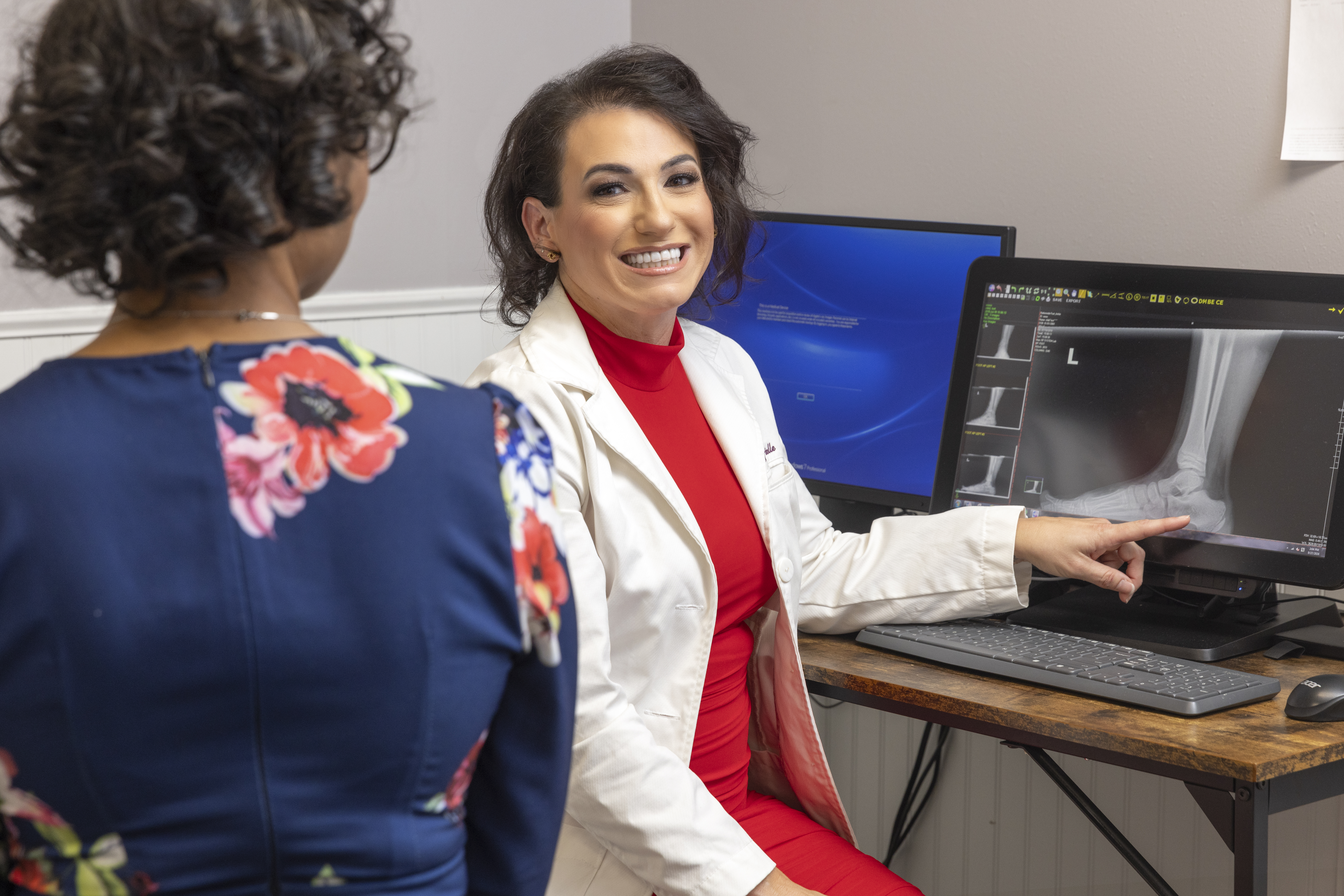
A physical examination can assess areas of tenderness, foot and ankle motion, the Achilles tendon, plantar fascia and other structures that may be involved.
Imaging is not automatically necessary for every case of plantar heel pain. X-rays or other testing may be considered when the history or examination suggests another condition, symptoms are unusual, or additional information is needed.
The goal is to treat the condition causing the heel pain—not simply the symptom itself.
Plantar Fasciitis Treatment
How Is Persistent Morning Heel Pain Treated?
When plantar fasciitis is responsible for morning heel pain, treatment is usually individualized around symptoms, contributing factors, activity level and response to previous care.
Stretching & Rehabilitation
A rehabilitation program may address calf flexibility, plantar fascia mobility, strength and movement depending on the patient’s examination.
Adjusting aggravating activity and using appropriate footwear may reduce repetitive stress while symptoms improve.
Custom Orthotics
Orthotics may be considered when foot mechanics or pressure distribution contribute to symptoms. They support the foot but do not permanently change the shape of an adult arch.
Night splints may be appropriate for some patients with persistent plantar fasciitis. They are intended to maintain a prolonged stretch while sleeping and are not necessary for every patient.
Shockwave Therapy
Extracorporeal shockwave therapy may be considered for selected cases of persistent plantar fasciitis that have not improved adequately with initial conservative treatment.
Other treatments may be considered depending on the diagnosis and severity of symptoms. Surgery is generally reserved for selected persistent cases rather than serving as the first treatment for typical plantar fasciitis.
When to Get Help
When Should I See a Podiatrist for Morning Heel Pain?
An occasional mild ache may improve with simple changes, but persistent or worsening heel pain deserves more attention.
Consider scheduling an evaluation when:
Morning heel pain keeps returning
Pain is interfering with walking or exercise
Symptoms are progressively worsening
Pain persists despite activity changes
You have numbness, burning or tingling
You are unsure what is causing the pain
More urgent evaluation is appropriate after a significant injury, with severe pain or deformity, inability to bear weight, rapidly increasing swelling or redness, or a sudden change in the color or temperature of the foot.
Patients with diabetes, neuropathy, impaired circulation or an open wound should also use additional caution with new foot symptoms.
Important
Don’t Assume Every Morning Heel Pain Is Plantar Fasciitis
The classic first-step pattern makes plantar fasciitis an important possibility, but treatment works best when it is directed at the actual cause.
If symptoms are persistent, unusual or worsening, an examination can help distinguish plantar fascia pain from Achilles tendon problems, arthritis, nerve-related symptoms, stress injuries and other causes.
Frequently Asked Questions About Morning Heel Pain
Why does my heel hurt when I wake up?
Pain beneath the heel during the first steps after waking is commonly associated with plantar fasciitis. The irritated plantar fascia can be particularly sensitive when it is suddenly loaded after several hours of rest. Other conditions can also cause morning heel pain, so persistent symptoms should not be self-diagnosed based on timing alone.
Why does my heel hurt in the morning but get better after walking?
This first-step pain pattern is commonly seen with plantar fasciitis. Symptoms may decrease as you begin moving and the tissues are loaded more gradually, although pain can return after prolonged standing, walking, exercise or another period of rest.
What are common plantar fasciitis symptoms?
Common symptoms include pain beneath or toward the inner side of the heel, pain with the first steps after waking or resting, tenderness near the bottom of the heel and symptoms that may return after prolonged standing or activity.
Can Achilles tendonitis cause morning heel pain?
Achilles tendon problems can cause pain and stiffness after rest. Achilles-related pain is generally felt at the back of the heel or along the tendon rather than on the bottom of the heel where plantar fasciitis commonly causes symptoms.
Does a heel spur cause morning heel pain?
Not necessarily. Heel spurs can occur alongside plantar fascia problems, but a spur seen on imaging does not automatically mean it is responsible for the pain. Some people have heel spurs without symptoms.
How long does plantar fasciitis take to improve?
Recovery varies depending on symptom duration, severity, activity demands, contributing factors and treatment. Some cases improve with conservative care, while persistent cases can require a longer treatment and rehabilitation period.
Should I walk if I have plantar fasciitis?
Walking tolerance varies. Normal daily walking may be manageable for some people, while prolonged walking or high-impact activity can aggravate symptoms in others. Activity may need to be temporarily adjusted according to symptoms and the treatment plan.
When should I see a podiatrist for heel pain?
Consider seeing a podiatrist when heel pain persists, repeatedly returns, worsens, interferes with walking or activity, or occurs with numbness, burning or other unusual symptoms. Severe pain after an injury, significant deformity or inability to bear weight warrants more prompt evaluation.
Take the Next Step
Tired of Starting Your Day With Heel Pain?
If heel pain is making those first morning steps uncomfortable, Nationwide Foot & Ankle Care can evaluate the cause and discuss treatment options based on your symptoms and needs.
A Parent’s Guide to Children’s Orthotics, Foot Pain, Flat Feet & Growing Feet
Learn when pediatric orthotics may help, when they may not be necessary, and how a foot and ankle evaluation can help determine what is appropriate for your child.
Parents often notice things about the way their children stand, walk, or run long before a child complains about a specific foot problem. Maybe your child’s arches look unusually low. Their shoes wear unevenly. They complain that their feet hurt after sports. Perhaps they tire quickly on long walks, or you have noticed that their feet seem to roll inward when they stand.
It is natural to wonder whether children’s orthotics could help.
The answer depends on the child. Not every child with flat feet, unusual-looking arches, or a different walking pattern needs custom orthotics. Children’s feet change considerably as they grow, and many variations in foot shape and alignment can be part of normal development.
For children who experience pain, fatigue, abnormal pressure, difficulty participating in activities, or certain biomechanical foot problems, however, pediatric orthotics may be one part of an individualized treatment plan.
At Nationwide Foot & Ankle Care, P.C., our podiatrists evaluate pediatric foot and gait concerns at our Livonia and Royal Oak offices for families throughout Metro Detroit and Southeast Michigan.
What Are Children’s Orthotics?
Orthotics are devices worn inside shoes to provide support, redistribute pressure, accommodate certain structural differences, or influence how forces move through the foot during standing, walking, and running.
The word orthotics covers several different products. A soft cushioning insert purchased at a store is not the same as a prescription device designed specifically for a child’s feet.
Over-the-Counter Shoe Inserts
Prefabricated inserts are made in standard sizes rather than for one specific foot. Depending on the product, they may provide additional cushioning or general arch support and can be sufficient for some children with relatively simple needs.
Custom Orthotics for Children
Custom orthotics for children are prescribed based on an individual evaluation and designed around the child’s foot structure, symptoms, biomechanics, and treatment goals. The design can vary depending on what the device is intended to accomplish.
The most expensive or most customized option is not automatically the best option. The goal is to determine whether an orthotic is appropriate in the first place and, if so, what type of support makes sense for that particular child.
Signs Your Child May Benefit From a Foot Evaluation
Foot shape alone does not determine whether a child needs orthotics. Symptoms and function are often more useful clues.
Recurring Foot or Ankle Pain
Children should not routinely have to stop normal activities because their feet hurt. Repeated arch, heel, ankle, or other foot pain deserves evaluation, particularly when symptoms consistently occur during walking, running, or sports.
Foot Fatigue During Activity
A child who regularly complains that their feet feel tired, sore, or uncomfortable much sooner than expected may have a foot or gait issue worth evaluating.
Painful Flat Feet
Flat feet are common during childhood and often cause no problems. When low arches are accompanied by pain, stiffness, pressure areas, limited motion, or difficulty with activities, further evaluation may be appropriate.
Recurring Sports-Related Symptoms
Running and jumping place repeated forces through growing feet. If a child repeatedly develops foot discomfort during sports, the podiatrist can assess whether footwear, training, an injury, foot mechanics, or another factor may be contributing.
Unusual Shoe Wear or Pressure Areas
Markedly uneven wear, repeated blisters, calluses, or areas where the shoe consistently rubs can provide useful clues about how pressure is being distributed across the child’s foot.
Changes in Walking or Activity
Limping, avoiding activities, difficulty keeping up with peers, or a noticeable change in the way a child walks warrants attention. Orthotics may or may not be part of treatment depending on the underlying cause.
Important: Not Every Child With Flat Feet Needs Orthotics
A child’s foot can look flat and still be healthy, flexible, comfortable, and fully functional.
Flat feet are particularly common in young children because their feet are still developing. A visible arch often becomes more apparent as children grow. If a child has flexible flat feet without pain, stiffness, or functional limitations, treatment may not be necessary.
Orthotics should not be prescribed simply to make a normal, painless child’s arch look higher. Shoe inserts do not create an arch or guarantee that a child’s foot will develop differently.
When flat feet are painful, stiff, asymmetric, progressively changing, or interfering with activity, however, evaluation can help determine whether treatment is appropriate.
Pediatric Flat Feet
When Might Orthotics Help a Child With Flat Feet?
The distinction between painless flat feet and symptomatic flat feet is important.
When a child with flat feet experiences discomfort or functional problems, orthotics may sometimes be used to support the foot, redistribute pressure, or reduce mechanical strain. They may be combined with footwear recommendations, activity modification, stretching, physical therapy, or other treatments depending on the cause of the symptoms.
Children with stiff or rigid flat feet require a different evaluation because the loss of arch may occasionally be associated with an underlying structural condition.
What Problems Can Pediatric Orthotics Be Used For?
Orthotics for kids may be considered as part of treatment for selected foot and ankle problems. Whether they are appropriate depends on the diagnosis rather than simply how a child’s feet look.
Symptomatic Flexible Flat Feet
Orthotic support may help some children with flexible flat feet when the condition is associated with foot fatigue, discomfort, or other symptoms.
Abnormal Pressure or Friction
An orthotic may sometimes be designed to redistribute pressure away from areas that repeatedly become irritated during standing or activity.
Selected Sports-Related Problems
When foot mechanics contribute to a child’s symptoms, an orthotic may sometimes be incorporated into a broader sports injury treatment or prevention strategy.
Certain Foot Alignment or Structural Concerns
Some children have structural differences that change how pressure moves through the foot. Orthotics can sometimes provide support or accommodation depending on the diagnosis.
Heel or Arch Symptoms
Some causes of pediatric heel or arch discomfort may benefit from additional shoe support, although the correct treatment depends on what is actually causing the pain.
Other Biomechanical Foot Problems
Because children’s feet and gait patterns vary, a podiatric evaluation is important before assuming that an insert will correct a particular walking or alignment concern.
What Children’s Orthotics Cannot Do
Parents understandably want to address a potential foot problem early, but children’s orthotics are sometimes given more credit than they deserve. Understanding their limitations is just as important as understanding their potential benefits.
Orthotics Do Not Create an Arch
Putting an insert under a child’s foot can support the arch while the orthotic is being worn, but that does not mean the device will permanently create or develop an arch.
They Do Not Correct Every Gait Difference
Problems such as in-toeing and out-toeing can originate from different areas of the leg and hip as well as the foot. An insert cannot be assumed to correct a rotational difference without first identifying its cause.
They Are Not a Substitute for Diagnosis
Pain may come from bones, joints, tendons, ligaments, growth plates, nerves, skin, or an injury. An orthotic should not be used as a substitute for determining why a child is having symptoms.
Custom Orthotics vs. Store-Bought Inserts for Kids
One of the most common questions parents have is whether their child really needs a custom device or whether a store-bought insert will work.
Prefabricated Inserts
A quality over-the-counter insert may be reasonable for some children who need basic cushioning or support. These products are less individualized and are generally selected by shoe size.
Custom Pediatric Orthotics
Custom devices are prescribed for an individual child after evaluating their feet, symptoms, and biomechanics. They allow the design and support characteristics to be tailored more specifically to the treatment goal.
Custom does not automatically mean necessary. A podiatrist can help determine whether your child’s problem warrants a custom device, a prefabricated insert, a change in footwear, another treatment, or no treatment at all.
Can Orthotics Help Children Who Play Sports?
Young athletes place substantial repetitive loads on their feet and ankles. Running, jumping, cutting, and sudden changes in direction can expose problems that may not be noticeable during ordinary daily activity.
For some young athletes, foot mechanics may contribute to recurring discomfort or place excessive pressure on certain areas of the foot. When that is the case, pediatric orthotics may sometimes be used alongside appropriate footwear, rehabilitation, activity modification, strengthening, or other treatment.
However, an orthotic should not be used to simply mask an undiagnosed sports injury. Persistent heel pain, ankle pain, swelling, limping, or pain that affects performance should be evaluated.
In-toeing and out-toeing describe the direction a child’s feet point while standing or walking, but the cause can come from different parts of the lower extremity. Some rotational differences originate higher in the leg rather than in the foot itself.
Because of that, shoe inserts should not be assumed to correct in-toeing or out-toeing. Many common childhood rotational variations improve naturally with growth and do not require corrective shoes or orthotics.
If a gait difference is severe, painful, asymmetric, worsening, associated with frequent tripping, or interfering with activity, a pediatric foot and gait evaluation can help determine its source.
What Happens During a Pediatric Orthotics Evaluation?
Before recommending custom orthotics for a child, the first step is understanding the problem the device would be intended to address.
1. Symptoms & History
The podiatrist may ask when symptoms occur, what activities make them worse, whether there have been previous injuries, and whether similar foot patterns run in the family.
2. Foot & Ankle Examination
Foot shape, flexibility, joint motion, tenderness, strength, alignment, and other relevant findings can be assessed.
3. Gait Evaluation
When appropriate, observing how the child stands and walks can provide additional information about foot mechanics and lower-extremity alignment.
4. Footwear Review
Shoe fit, support, wear patterns, and the demands of the child’s activities or sports may also be considered.
5. Additional Testing When Needed
Many pediatric foot concerns can be evaluated clinically. X-rays or other testing may be recommended when symptoms, stiffness, injury, or structural findings warrant additional investigation.
6. Individual Treatment Plan
If treatment is appropriate, recommendations may include observation, footwear changes, exercises, physical therapy, orthotics, activity modifications, or another approach based on the diagnosis.
Do Children’s Feet Outgrow Custom Orthotics?
Children grow, and their feet grow with them. A device that fits properly today will not necessarily continue fitting indefinitely.
If your child wears custom orthotics, their feet, shoes, symptoms, and devices should be reassessed periodically. How often replacement is necessary depends on growth, wear, the orthotic design, and whether the child’s treatment needs have changed.
Parents should also pay attention to signs that an orthotic may no longer fit properly, including new pressure areas, discomfort, difficulty fitting the device into appropriately sized shoes, or a noticeable growth spurt.
Does My Child Have to Wear Orthotics Forever?
Not necessarily. The duration of orthotic use depends on why the device was prescribed and how the child’s symptoms and feet change over time. Some children may use orthotics during a particular stage of growth or activity, while others with ongoing structural or biomechanical needs may benefit from longer-term support.
The decision should be reassessed as the child grows rather than assuming that a prescription made years earlier will always remain necessary.
What Shoes Should Children Wear With Orthotics?
The orthotic and the shoe work together. Even a well-designed device may be uncomfortable or ineffective if the shoe does not fit properly.
Depending on the child’s needs, useful footwear characteristics may include:
Enough length and width for the child’s foot without crowding the toes
A secure fit around the heel
Enough internal depth to accommodate the orthotic comfortably
A removable factory insole when additional space is needed
A secure closure such as laces or hook-and-loop straps
A shoe appropriate for the child’s activities
Because children’s feet grow quickly, shoe size should be checked regularly. Shoes should not require a painful “break-in” period.
The Bottom Line for Parents
How Do I Know If My Child Really Needs Custom Orthotics?
You generally cannot determine the need for custom orthotics based only on how a child’s arch looks.
A more useful question is whether your child has pain, fatigue, recurring symptoms, abnormal pressure, stiffness, activity limitations, or another diagnosed foot problem that could benefit from additional support.
If your child runs, plays, and participates comfortably and simply has low arches, orthotics may not be necessary. If something is painful, changing, or limiting what they can do, an evaluation can help determine why.
Pediatric Podiatry in Metro Detroit
Children’s Orthotics in Livonia & Royal Oak, MI
If your child has recurring foot pain, painful flat feet, sports-related symptoms, or another foot or gait concern, Nationwide Foot & Ankle Care, P.C. can evaluate the problem and help determine whether orthotics are appropriate.
Our approach begins with identifying the reason for your child’s symptoms rather than assuming every child needs an insert. Depending on the evaluation, recommendations may include monitoring, footwear changes, exercises, physical therapy, an over-the-counter insert, custom orthotics, or another treatment.
Nationwide Foot & Ankle Care provides pediatric foot and ankle care at offices in Livonia and Royal Oak, Michigan, serving families throughout Metro Detroit and surrounding Southeast Michigan communities.
Frequently Asked Questions About Children’s Orthotics
How do I know if my child needs orthotics?
A child may benefit from evaluation if they have recurring foot or ankle pain, painful flat feet, unusual pressure areas, foot fatigue, recurring activity-related symptoms, or another foot problem. The appearance of a child’s arch alone does not determine whether orthotics are necessary.
Do all children with flat feet need orthotics?
No. Flexible flat feet are common in children, and painless flat feet often do not require treatment. Evaluation is more important when flat feet are painful, stiff, asymmetric, changing, or interfering with activity.
Will orthotics create an arch in my child’s feet?
Orthotics can support a child’s foot while they are being worn, but they should not be expected to permanently create an arch or change normal arch development.
Are custom orthotics better than store-bought inserts for kids?
Not necessarily. Prefabricated inserts may provide sufficient cushioning or support for some children. Custom orthotics allow a device to be designed around an individual child’s foot and treatment needs when greater customization is appropriate.
Can children’s orthotics help with foot pain?
They may help selected types of foot pain when mechanics or pressure contribute to symptoms. Because children’s foot pain has many possible causes, the underlying problem should be evaluated before assuming an orthotic is the correct treatment.
Can orthotics fix in-toeing or out-toeing?
Not necessarily. In-toeing and out-toeing can originate from different parts of the foot, leg, or hip, and many childhood rotational variations improve naturally. An evaluation can help determine the cause and whether treatment is necessary.
Can kids wear orthotics while playing sports?
Some children use orthotics in athletic footwear when they are part of a treatment plan. The device and shoe should fit appropriately, and sports-related pain should be evaluated rather than simply covered up with an insert.
Will my child outgrow custom orthotics?
Children’s feet grow, so orthotics should be reassessed periodically. Replacement depends on growth, wear, fit, the type of device, and whether the child’s treatment needs have changed.
How long does a child need to wear orthotics?
There is no single timeline. Duration depends on why the orthotics were prescribed, the child’s symptoms, growth, activity level, and how their foot mechanics change over time.
What shoes work best with children’s orthotics?
The shoe should fit the child’s foot properly and have enough room to accommodate the orthotic without crowding the foot. A secure heel, appropriate width and depth, and removable factory insole can be helpful depending on the device.
At what age can a child get custom orthotics?
There is no universal age at which every child should receive orthotics. The decision is based on the child’s condition, symptoms, development, and treatment needs rather than age alone.
Where can I have my child evaluated for orthotics in Metro Detroit?
Nationwide Foot & Ankle Care, P.C. provides pediatric foot and ankle evaluations at its Livonia and Royal Oak, Michigan offices. Parents can request an appointment online to discuss foot pain, flat feet, gait concerns, sports-related symptoms, and whether orthotics may be appropriate.
Concerned About Your Child’s Feet?
If your child has foot pain, painful flat feet, activity-related symptoms, or another foot or gait concern, schedule an evaluation at Nationwide Foot & Ankle Care in Livonia or Royal Oak.
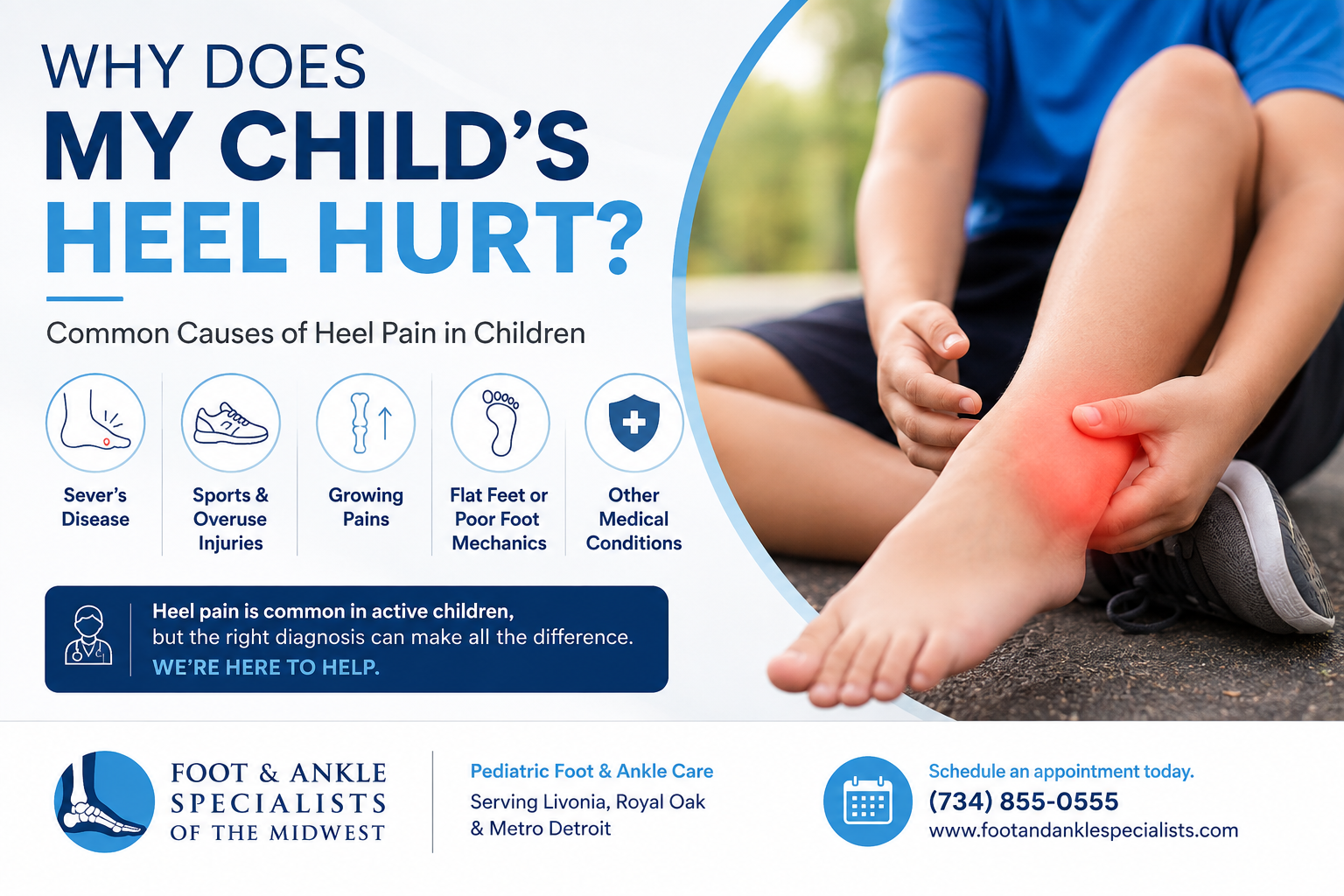
When a child starts complaining about heel pain, parents often wonder whether it is simply soreness from sports, a normal part of growing, or something that needs professional attention. Heel pain in children is common, especially in active kids and young athletes, but recurring pain should not automatically be dismissed as “growing pains.”
Children’s feet are still developing. Their bones, growth plates, muscles, tendons, and walking mechanics continue changing throughout childhood and adolescence. Because of this, pediatric heel pain often has different causes than heel pain in adults. Conditions such as Sever’s disease, growth plate irritation, overuse injuries, tight calf muscles, sports-related stress, and changes in foot mechanics are all possible reasons a child may begin experiencing pain around the heel.
Some children first notice pain after soccer practice, basketball, gymnastics, track, dance, or another high-impact activity. Others may begin limping at the end of the day, complain that the heel hurts when they first stand up, or avoid running because the pain keeps returning. The location, timing, and pattern of the symptoms can provide important clues about what is causing the problem.
At Nationwide Foot & Ankle Care, P.C., we evaluate pediatric heel pain for families throughout Livonia, Royal Oak, Metro Detroit, and Southeast Michigan. Our goal is to determine whether your child is experiencing a temporary developmental issue, a sports-related overuse injury, Sever’s disease, or another condition that may benefit from treatment.
Is Heel Pain Normal in Children?
Occasional soreness after an unusually active day can happen in children just as it can in adults. A long soccer tournament, a day at an amusement park, or a sudden increase in running may temporarily leave the feet and legs tired. Mild soreness that improves quickly with rest is usually less concerning.
Recurring or persistent heel pain is different. A healthy child should generally be able to walk, run, jump, participate in sports, and play without repeatedly developing pain in the same location. If the heel hurts after every practice, causes limping, changes the way your child walks, or begins limiting normal activity, the symptoms deserve a closer look.
One important difference between children and adults is the presence of active growth plates. Growth plates are areas of developing tissue near the ends of certain bones. They allow bones to lengthen as a child grows, but they can also become irritated by repeated stress. The growth plate at the back of the heel is especially vulnerable during periods of rapid growth and athletic activity.
This is one reason heel pain in children commonly appears during late elementary school and early adolescence, when growth spurts and sports participation often overlap.
The Most Common Cause of Heel Pain in Children: Sever’s Disease
The most common cause of heel pain in active children is Sever’s disease, also known as calcaneal apophysitis. Despite the name, Sever’s disease is not an infection and is not a disease in the traditional sense. It is an overuse-related irritation of the growth plate at the back of the heel bone.
The heel bone, or calcaneus, continues developing throughout childhood. Near the back of the heel is a growth plate where the Achilles tendon attaches. During a growth spurt, the heel bone may lengthen more quickly than the surrounding muscles and tendons can adapt. This can increase tension from the Achilles tendon and place repeated pulling forces on the developing heel.
When running, jumping, sprinting, or changing direction repeatedly, the heel absorbs significant impact while the Achilles tendon continues pulling on the growth plate. Over time, this combination can irritate the area and produce the pain associated with Sever’s disease.
Children with Sever’s disease may complain of pain at the back or bottom of the heel, particularly during sports or immediately afterward. Symptoms may affect one heel or both heels and often improve during periods of rest before returning once activity resumes.
What Age Does Sever’s Disease Usually Occur?
Sever’s disease most commonly affects school-aged children and young adolescents whose heel growth plates are still open. It often appears during the years when children are growing rapidly and becoming more involved in organized sports.
Parents often first notice symptoms between roughly ages 8 and 14, although the exact timing varies based on the child’s development. Once the growth plate has matured and closed, Sever’s disease is no longer a cause of heel pain.
The condition may flare during a growth spurt and then improve, only to return when sports intensity increases. This pattern can be frustrating because a child may seem fully recovered during a quieter period and then develop pain again when practices, tournaments, or conditioning resume.
What Does Sever’s Disease Feel Like?
Children often describe the discomfort as soreness, aching, tenderness, or a bruised feeling around the heel. Some may have difficulty explaining the pain precisely and simply say their “foot hurts.”
Common patterns include:
Pain at the back or bottom of the heel
Heel pain during or after running
Pain after soccer, basketball, gymnastics, dance, track, or other sports
Limping after practice or games
Walking on the toes to avoid heel pressure
Tenderness when the sides of the heel are squeezed
Symptoms that improve with rest and return with activity
Pain affecting one or both heels
Children may continue participating in sports despite these symptoms, especially if they are worried about missing games or disappointing teammates. Parents should pay attention when a child begins changing the way they run, avoids putting the heel on the ground, or becomes reluctant to participate in activities that were previously comfortable.
Why Does My Child’s Heel Hurt After Sports?
Child heel pain after sports is especially common because running and jumping repeatedly load the heel and Achilles tendon. Sports involving sprinting, cutting, jumping, or frequent changes in direction can place thousands of repetitive forces through the feet during a single week of practices and games.
A child may feel fine before practice and begin developing pain halfway through the session. Others may complete the entire game but limp afterward or complain about pain once they get home. Symptoms can also be worse the morning after a tournament or during the first few steps after sitting for an extended period.
The problem may become more noticeable when training volume increases suddenly. Moving from a recreational schedule to multiple practices each week, starting a new season, attending sports camps, joining travel teams, or playing several sports at once can dramatically increase the amount of stress placed on growing feet.
Growth spurts can make this even more noticeable. As bones lengthen, the calf muscles and Achilles tendon may temporarily become relatively tight. That increased tension can place additional pulling stress around the heel and make running or jumping uncomfortable.
Sports Commonly Associated With Pediatric Heel Pain
Any activity involving repeated impact can aggravate heel pain, but certain sports place especially high demands on the heel and Achilles tendon.
Soccer
Basketball
Football
Track and field
Cross-country
Volleyball
Gymnastics
Dance
Cheerleading
Tennis
Lacrosse
Baseball and softball
This does not mean children should avoid these activities. Sports provide important physical, social, and emotional benefits. The goal is to recognize symptoms early and adjust training when necessary rather than allowing repeated pain to become more severe.
Is Heel Pain Just Growing Pains?
Parents are frequently told that leg or foot discomfort is simply a normal part of growing. True growing pains do occur, but they generally have a different pattern from localized heel pain caused by an overuse injury or growth plate irritation.
Growing pains more commonly affect both legs and are often described as aching in the calves, thighs, or behind the knees. They tend to occur in the evening or at night and usually do not cause persistent tenderness in one specific location.
By contrast, pediatric heel pain that consistently appears during sports, hurts when the heel is pressed, causes limping, or worsens with running is more likely to involve a local foot or ankle condition.
Parents should be cautious about using “growing pains” as an explanation for recurring pain that affects activity. Growth may contribute to the underlying problem, but that does not mean the symptoms should simply be ignored.
Why Growth Spurts Can Trigger Heel Pain
Growth does not occur evenly throughout the entire body. During certain stages of childhood and adolescence, bones may lengthen quickly while the surrounding muscles and tendons take time to adapt.
The calf muscles and Achilles tendon are especially important because they attach near the back of the heel. When these structures become relatively tight during a growth spurt, the tension placed on the heel can increase.
Now add repetitive sports activity to that tightness. Every sprint, jump, landing, and push-off creates additional force through the heel. This combination of rapid skeletal growth and high activity is one reason Sever’s disease is so common among young athletes.
Some children may also appear temporarily less coordinated during growth spurts. Changes in leg length, body proportions, strength, and flexibility can alter running mechanics and place stress on areas that previously tolerated activity without difficulty.
Other Causes of Heel Pain in Children
Although Sever’s disease is one of the most common causes of heel pain in active children, it is not the only possibility. Several other conditions can produce pain around the heel, which is why persistent symptoms should be evaluated rather than diagnosed based only on age or sports participation.
Achilles Tendon Irritation
The Achilles tendon can become irritated from repetitive activity, sudden increases in training, tight calf muscles, or changes in biomechanics. Children may experience pain or tenderness behind the ankle or near the point where the tendon approaches the heel.
Achilles-related pain may resemble Sever’s disease because both conditions occur near the back of the heel. The age of the child, location of tenderness, flexibility, and examination findings help determine which structure is causing the symptoms.
Plantar Fascia Irritation
The plantar fascia is a strong band of connective tissue running along the bottom of the foot from the heel toward the toes. Although plantar fasciitis is much more common in adults, older children and teenagers can occasionally develop irritation in this region, especially when activity levels, foot mechanics, or muscle tightness contribute to increased strain.
Heel Bone Stress Injuries
Repetitive impact can occasionally lead to a stress reaction or stress fracture in the heel bone. These injuries may develop gradually rather than after one dramatic event and can become more painful as activity continues.
Unlike typical Sever’s disease, a stress injury may cause more consistent pain with weight-bearing and may not improve as quickly with short periods of rest. Imaging may be recommended when a bone injury is suspected.
Heel Bruises and Direct Trauma
A direct fall onto the heel, repeated jumping on a hard surface, or being stepped on during sports can bruise the soft tissue beneath the heel. Children may experience tenderness when standing or walking directly on the affected area.
Flat Feet and Foot Mechanics
Flat feet do not automatically cause heel pain, and many children with flexible flat feet remain completely comfortable. However, when low arches are associated with excessive strain, tightness, or abnormal mechanics, they may contribute to discomfort around the heel or Achilles tendon in some children.
This is especially relevant when heel pain occurs alongside foot fatigue, recurring ankle problems, or difficulty keeping up during sports.
Tarsal Coalition
Tarsal coalition is an abnormal connection between two or more bones in the foot. It may not cause noticeable symptoms during early childhood, but as the bones mature, some children develop stiffness, recurring ankle sprains, flat-foot appearance, and pain around the rearfoot or heel.
A child with a very stiff foot, recurring pain, or limited side-to-side motion may need additional imaging to determine whether an underlying structural condition is present.
Inflammatory or Systemic Conditions
Heel pain is usually related to local overuse or growth, but less common medical conditions can also affect children’s feet. Inflammatory arthritis, infections, and other systemic conditions may produce heel pain along with swelling, redness, stiffness, fever, or symptoms elsewhere in the body.
Heel pain accompanied by significant swelling, warmth, fever, unusual fatigue, or symptoms that occur even at rest should be evaluated promptly.
Signs Your Child’s Heel Pain Needs a Closer Look
Children do not always explain pain clearly. Some can point directly to the heel and describe when it hurts, while others may simply slow down, stop running, ask to be carried, or lose interest in activities they normally enjoy. These changes in behavior can be just as important as the pain itself.
Parents should pay attention to patterns. Heel pain in children that appears after every practice, worsens during sports, causes limping, or repeatedly returns after rest may indicate more than simple muscle fatigue.
Warning signs that deserve evaluation include:
Heel pain lasting more than several days
Pain that returns every time your child runs or plays sports
Limping during or after activity
Walking on the toes to avoid heel pressure
Pain severe enough to stop sports or playground activity
Tenderness when the heel is touched or squeezed
Swelling, redness, or warmth around the heel
Difficulty putting weight on the foot
Pain that occurs at rest or wakes your child at night
Recurring pain affecting only one heel
Pain following a fall, collision, or direct injury
Most pediatric heel pain is not dangerous, but a professional evaluation helps determine whether the symptoms are related to growth, sports overuse, Sever’s disease, a tendon problem, a bone injury, or another condition requiring a different treatment approach.
How Pediatric Heel Pain Is Diagnosed
Diagnosing pediatric heel pain starts with understanding when the symptoms began, what activities make them worse, and whether your child has recently experienced a growth spurt, sports injury, or major change in activity level.
Your podiatrist may ask whether the pain occurs in one heel or both, whether it is worse during sports, whether your child limps afterward, and whether rest improves the symptoms. Shoes, training schedules, previous injuries, medical history, and family foot structure may also provide useful information.
Physical Examination
During the physical examination, the podiatrist evaluates the heel, Achilles tendon, foot structure, ankles, calves, and surrounding joints. Areas of tenderness are identified and compared between both sides.
The examination may include checking:
Heel tenderness
Achilles tendon flexibility
Calf muscle tightness
Foot and ankle range of motion
Flat feet or high arches
Foot and leg alignment
Balance and strength
Swelling or bruising
Areas of pain during weight-bearing
In suspected Sever’s disease, tenderness around the heel growth plate and pain associated with activity are important findings. Your podiatrist also looks for clues that suggest a fracture, tendon injury, structural condition, or another cause of heel pain.
Walking and Gait Evaluation
Watching your child walk can reveal movement patterns that are not obvious while sitting on an examination table. The podiatrist may evaluate whether the feet turn inward or outward, whether the arches collapse, how the heels move, and whether your child avoids pressure on the painful side.
For young athletes, running mechanics can be especially useful. A child may compensate for heel pain by shortening their stride, landing differently, or shifting weight toward the opposite foot. These adjustments may help explain why pain persists or why other areas begin to feel sore.
Are X-Rays Needed for Heel Pain in Children?
Not every child with heel pain needs an X-ray. Many cases of Sever’s disease can be identified based on age, symptoms, activity pattern, and physical examination.
X-rays may be recommended when the pain is severe, follows a traumatic injury, affects only one side in an unusual pattern, does not improve as expected, or when the examination raises concern for a fracture, bone abnormality, or another condition.
Additional imaging may occasionally be appropriate when a stress injury, tendon problem, tarsal coalition, infection, or another less common cause is suspected.
Treatment for Heel Pain in Children
Treatment depends on the diagnosis, severity of symptoms, age of the child, activity level, and whether the pain is interfering with walking, school, or sports. Fortunately, most causes of heel pain in children can be treated without surgery.
For Sever’s disease and many overuse-related conditions, the goal is to reduce stress on the irritated heel while maintaining enough flexibility, strength, and support for the child to return safely to activity.
Activity Modification
One of the most effective first steps is temporarily reducing activities that repeatedly trigger the pain. This does not always mean complete inactivity.
A child may be able to participate in lower-impact conditioning, swimming, cycling, or modified practice while reducing running and jumping. The exact level of activity should be based on symptoms and the underlying diagnosis.
If your child is limping or changing the way they run because of pain, continuing full sports participation is usually not a good idea. Playing through significant pain can prolong irritation and create compensatory movement patterns.
Ice After Activity
Cold therapy may help reduce soreness after sports or periods of increased activity. Ice should be wrapped in a thin towel rather than placed directly against the skin.
Parents should follow the treatment recommendations provided for their child rather than relying on ice alone if pain continues returning.
Calf and Achilles Stretching
Tight calf muscles and Achilles tendons can increase pulling stress around the developing heel. Stretching may be especially helpful during growth spurts when flexibility temporarily decreases.
A stretching program may include gentle calf stretches with the knee straight and bent to address different muscle groups. The exercises should feel like a mild stretch rather than sharp pain.
Consistency matters. Stretching only once after pain becomes severe is less useful than maintaining flexibility throughout a sports season.
Supportive Shoes
Children with heel pain often benefit from athletic shoes that provide adequate cushioning and fit properly. Shoes that are excessively worn, too small, too flexible, or poorly matched to the sport can increase discomfort.
Because children’s feet grow quickly, shoe size should be checked regularly. A shoe that fit comfortably at the beginning of a season may become too tight only a few months later.
Parents should also look at the condition of the shoe rather than age alone. Compressed midsoles, uneven wear, damaged heel counters, and worn tread can reduce support even when the shoe still looks acceptable from the outside.
Heel Cups and Cushioned Inserts
Heel cups or cushioned inserts may help reduce impact and provide additional comfort during walking and sports. They can be particularly useful when symptoms are related to repeated loading of the heel.
The best option depends on the child’s foot structure, shoes, and activity. An insert should fit comfortably inside the shoe without crowding the toes or changing the fit significantly.
Custom Orthotics
Not every child with heel pain needs custom orthotics. However, they may be considered when foot mechanics, flat feet, recurring injuries, or persistent symptoms contribute to abnormal stress around the heel.
Custom orthotics are designed to support the foot and redistribute pressure based on the child’s individual mechanics. Their purpose is not simply to “build an arch,” but to improve comfort and function when a specific biomechanical issue is contributing to symptoms.
Physical Therapy
Physical therapy may be recommended when heel pain is associated with significant muscle tightness, weakness, poor balance, abnormal running mechanics, or recurring sports injuries.
Therapy can address more than the painful heel. Exercises may focus on calf flexibility, ankle strength, hip strength, balance, landing mechanics, and sport-specific movement patterns that influence stress throughout the lower body.
Temporary Immobilization for Severe Pain
Most children with Sever’s disease do not need a walking boot. However, temporary immobilization may be considered when pain is severe, walking is difficult, or symptoms are not improving with more basic treatment.
Immobilization reduces repeated stress on the painful area and allows irritated tissues time to settle. Your podiatrist will determine whether this is appropriate based on the severity of the symptoms.
Pain Medication
Over-the-counter pain or anti-inflammatory medication may be appropriate for some children, but parents should use medication only according to the child’s age, health history, product instructions, and guidance from an appropriate healthcare professional.
Medication should not be used simply to allow a child to continue playing through an injury that is causing significant pain.
How Long Does Sever’s Disease Last?
One of the most common questions parents ask is how long heel pain from Sever’s disease will last. The answer varies because symptoms are influenced by growth, activity level, flexibility, sports schedule, and how quickly treatment begins.
Some children improve within a few weeks after reducing aggravating activity and following a consistent stretching and support program. Others experience flare-ups that come and go throughout a growth period, particularly when sports intensity increases.
Sever’s disease is self-limited because the heel growth plate eventually matures. Once that growth plate closes, calcaneal apophysitis is no longer a cause of heel pain.
That does not mean children should simply tolerate pain until they finish growing. Symptoms can often be managed effectively so that the child remains comfortable and active during development.
Can Sever’s Disease Cause Permanent Damage?
Sever’s disease does not usually cause permanent damage to the heel growth plate. It is an irritation associated with growth and repetitive stress rather than a destructive condition.
The larger concern is how pain affects your child in the short term. A child who continues running while limping may change movement patterns, lose flexibility, or begin placing additional stress on the opposite leg and other joints.
Managing symptoms early can help reduce unnecessary discomfort and allow for a safer return to normal activity.
Can My Child Play Sports With Sever’s Disease?
Some children with mild symptoms can remain active with treatment and appropriate modifications. Others need a temporary break from running and jumping until pain decreases.
The most important factor is function. A child should not be encouraged to play through pain that causes limping or significantly changes movement.
A practical way to judge activity tolerance is to look at what happens during and after sports. If your child can participate comfortably and remains pain-free afterward, the activity may be acceptable. If pain steadily increases, causes limping, or remains significantly worse the next day, the current level of activity may be too high.
Young athletes often need help making this decision because they may minimize symptoms to stay on the field. Parents, coaches, therapists, and podiatrists can work together to find a balance between recovery and maintaining appropriate conditioning.
When Can My Child Return to Sports?
Returning to sports should be based on function rather than a specific number of days. The amount of time away from full activity varies depending on the diagnosis and severity of symptoms.
Before returning fully, your child should generally be able to:
Walk without limping
Run without significant heel pain
Jump comfortably
Move the ankle through a functional range of motion
Complete sport-specific movements without compensating
Participate without symptoms becoming significantly worse afterward
Returning gradually is often better than going directly from complete rest to a full tournament weekend. Practices, conditioning, and game time may be increased step by step as symptoms allow.
How to Help Prevent Heel Pain in Young Athletes
Not every case of pediatric heel pain can be prevented. Growth itself is not something parents can control, and active children will always experience some bumps and soreness. However, several habits may help reduce excessive stress on developing feet.
Increase Training Gradually
Sudden increases in running distance, practice frequency, tournament volume, or conditioning intensity can overload tissues that have not had time to adapt.
Whenever possible, training should increase gradually rather than doubling overnight because a new season begins.
Maintain Flexibility
Regular calf and Achilles stretching may help children maintain flexibility during growth spurts. Flexibility becomes especially important when sports involve repeated sprinting, jumping, or cutting.
Use Appropriate Athletic Shoes
Shoes should fit the child’s current foot size and match the activity being performed. Running shoes, basketball shoes, soccer cleats, and dance footwear are designed for different movement demands.
A child should not continue wearing shoes that are too small simply because they have not visibly worn out.
Replace Worn Shoes
Athletic footwear loses cushioning and structure with use. Children involved in frequent practices may wear through shoes much faster than parents expect.
Check for excessive tread wear, uneven compression, collapsed midsoles, and damaged heel counters.
Allow Recovery Time
Children who participate in organized sports year-round may have very little opportunity for recovery. Multiple teams, overlapping seasons, and weekend tournaments can create a training load that resembles adult athletics while the body is still growing.
Rest days and periods of lower-impact activity can help reduce repetitive stress.
Do Not Ignore Recurring Pain
Early heel pain is often easier to manage than symptoms that have been present for months. Encourage children to tell parents and coaches when something hurts rather than hiding pain to avoid missing a game.
Choosing Shoes for a Child With Heel Pain
Shoes alone do not treat every cause of heel pain, but poor-fitting or worn footwear can aggravate an already irritated heel.
Look for shoes that:
Fit properly in both length and width
Provide adequate cushioning under the heel
Hold the heel securely
Do not rub against the painful area
Are appropriate for the child’s sport
Have not lost their cushioning or structural support
If your child uses cleats, skates, dance shoes, or other specialized footwear, bring them to the appointment when possible. These shoes can provide useful clues about pressure points and fit.
Common Myths About Heel Pain in Children
Myth: Heel Pain Is Always Just Growing Pains
Growth can contribute to heel pain, but localized pain that repeatedly occurs during sports may represent Sever’s disease or another foot and ankle condition. Persistent pain should not be dismissed simply because a child is growing.
Myth: My Child Has to Stop Sports Completely
Not necessarily. Some children can continue selected activities with modifications, while others need a temporary reduction in impact. The appropriate recommendation depends on pain severity and diagnosis.
Sever’s disease is generally temporary and resolves when the heel growth plate matures. Treatment focuses on controlling symptoms and maintaining healthy movement during the growth period.
Myth: Only Competitive Athletes Develop Heel Pain
Competitive athletes are at higher risk because of repeated impact, but any active child can develop heel pain. Playground activity, recreational running, dance, physical education, and sudden increases in exercise can also trigger symptoms.
Myth: If My Child Can Still Play, the Heel Is Fine
Children sometimes continue playing despite significant pain. Look for limping, toe walking, reduced speed, shorter strides, or complaints after activity rather than relying only on whether your child stays in the game.
When Should My Child See a Podiatrist for Heel Pain?
Parents do not need to wait until heel pain becomes severe. An evaluation can often determine whether symptoms are part of a common growth-related condition or whether another injury needs treatment.
Consider scheduling a pediatric foot evaluation if your child:
Has heel pain that repeatedly returns
Limps after sports or activity
Walks on the toes to avoid heel pressure
Stops participating in activities because of pain
Has pain in the same location for more than several days
Experiences pain with normal walking
Has swelling, bruising, redness, or warmth
Cannot comfortably bear weight
Has symptoms after a fall or traumatic injury
Has heel pain that is getting worse despite rest
A pediatric podiatrist can help distinguish between Sever’s disease, tendon problems, stress injuries, foot mechanics, and other possible causes of heel pain in children.
Pediatric Heel Pain Treatment in Metro Detroit
At Nationwide Foot & Ankle Care, P.C., we provide pediatric foot and ankle evaluations for children experiencing heel pain, Sever’s disease, sports injuries, flat feet, walking abnormalities, recurring ankle injuries, and other conditions affecting growing feet.
Our goal is to determine what is causing your child’s pain and recommend treatment that supports comfort, healthy development, and a safe return to normal activity.
We proudly care for families throughout Livonia, Royal Oak, Detroit, Southfield, Dearborn, Dearborn Heights, Westland, Plymouth, Northville, Farmington Hills, Novi, Birmingham, West Bloomfield, Troy, Auburn Hills, Clawson, Commerce Township, and surrounding Southeast Michigan communities.
If your child repeatedly complains that their heel hurts after soccer, basketball, running, dance, gymnastics, or everyday activity, you do not have to guess whether it is normal. A comprehensive pediatric foot evaluation can provide answers and help determine the most appropriate next step.
Schedule a Pediatric Heel Pain Evaluation
If heel pain is causing your child to limp, avoid sports, or repeatedly complain after activity, schedule an evaluation with Nationwide Foot & Ankle Care, P.C.
Our podiatrists provide pediatric foot and ankle care for families throughout Livonia, Royal Oak, Metro Detroit, and Southeast Michigan.
Frequently Asked Questions About Heel Pain in Children
What is the most common cause of heel pain in children?
One of the most common causes is Sever’s disease, also called calcaneal apophysitis. It is an irritation of the heel growth plate that often affects active children during periods of rapid growth.
At what age does Sever’s disease occur?
Sever’s disease commonly occurs in school-aged children and young adolescents while the heel growth plate remains open, often around ages 8 to 14. Timing varies based on individual growth and development.
Why does my child’s heel hurt after soccer or basketball?
Running, jumping, cutting, and repeated impact can place stress on the developing heel and Achilles tendon. During growth spurts, this stress may irritate the heel growth plate and cause pain during or after sports.
Is heel pain in children just growing pains?
Not always. Growing pains typically cause more generalized leg aches, often at night. Localized heel pain that repeatedly occurs during sports, causes tenderness, or leads to limping may indicate Sever’s disease or another foot and ankle condition.
Can my child keep playing sports with Sever’s disease?
Some children can continue modified activity when symptoms are mild, while others need temporary rest from running and jumping. A child should not continue full sports participation if pain causes limping or significant changes in movement.
How is pediatric heel pain treated?
Treatment may include activity modification, stretching, supportive footwear, heel cups, ice, physical therapy, orthotics for selected patients, or temporary immobilization when symptoms are severe. Treatment depends on the underlying diagnosis.
How long does Sever’s disease last?
Some children improve within several weeks, while others experience occasional flare-ups during periods of growth and increased sports activity. The condition resolves once the heel growth plate matures.
Does Sever’s disease cause permanent damage?
Sever’s disease generally does not cause permanent damage to the heel. It is a temporary growth-related irritation, although symptoms should still be managed so the child can move comfortably and avoid compensating for pain.
When should I take my child to a podiatrist for heel pain?
Schedule an evaluation if heel pain repeatedly returns, causes limping, interferes with sports or normal walking, is associated with swelling or bruising, follows an injury, or does not improve with a short period of reduced activity.
Do children with heel pain need X-rays?
Not every child needs X-rays. Imaging may be recommended when the symptoms are unusual, severe, follow an injury, affect one side persistently, or when a fracture or another bone condition needs to be ruled out.
Flat feet are one of the most common concerns parents notice as their children begin standing, walking, running, and participating in sports. A parent may see that the arches appear low, the ankles lean inward, or the entire sole of the foot touches the floor. Others first notice that their child’s shoes wear unevenly or that their feet look different from those of other children.
In many cases, flat feet in children are a normal part of development. Babies and toddlers commonly have low or barely visible arches, and many children develop more noticeable arches as their bones, muscles, tendons, and ligaments mature. A painless, flexible flat foot that does not interfere with walking, playing, or sports may require nothing more than observation.
However, not every flat foot is the same. Pediatric flat feet should be evaluated when they cause pain, fatigue, limping, recurring ankle injuries, balance problems, difficulty participating in activities, or changes in the way a child walks. A rigid foot that remains flat in every position, a deformity affecting only one side, or a foot that appears to be worsening also deserves professional attention.
The challenge for parents is knowing the difference between a normal developmental variation and a condition that may benefit from treatment. At Nationwide Foot & Ankle Care, P.C., we help families throughout Livonia, Royal Oak, Metro Detroit, and Southeast Michigan understand how their children’s feet are developing and whether pain, walking changes, or activity limitations require additional care.
What Are Flat Feet?
A person has flat feet when the arch along the inside of the foot is low or appears to disappear while standing. The medical term is pes planus. When body weight is placed on the foot, a larger portion of the sole may contact the floor, and the heel may tilt outward while the ankle appears to lean inward.
The foot’s arch is more than a visible curve. It helps absorb shock, distribute pressure, adapt to uneven surfaces, and create an efficient lever for walking and running. The arch is supported by the shape of the bones as well as the surrounding muscles, ligaments, tendons, and connective tissues.
Children’s feet are still developing, so their arches may look very different from adult arches. A low arch does not automatically mean that a child has a medical problem. The more important questions are whether the foot is flexible, whether symptoms are present, and whether the foot is affecting movement or activity.
Understanding How Children’s Feet Develop
Children are not born with fully developed adult feet. Their bones, muscles, joints, ligaments, and walking mechanics continue changing throughout childhood and adolescence. Infants also have a natural layer of fat along the bottom of the foot that can hide the developing arch and make the foot look flatter than it is.
When toddlers begin walking, they often use a wide stance and take short, unsteady steps. Their feet may turn inward or outward, and their ankles may appear to lean toward the floor. These early walking patterns help children maintain balance while strength and coordination develop.
As children grow, the muscles supporting the feet become stronger and their walking pattern usually becomes more efficient. A visible arch may gradually develop, although the timing varies considerably from one child to another. Some healthy children and adults continue to have flexible flat feet without pain or functional limitations.
This natural variation is why treatment decisions should never be based on appearance alone. A pediatric foot evaluation considers age, symptoms, flexibility, walking mechanics, activity level, and whether the condition is changing over time.
Are Flat Feet Normal in Children?
Flat feet are extremely common among babies, toddlers, and younger children. Most painless, flexible flat feet do not interfere with normal development and do not require treatment simply because the arch appears low.
Parents should focus less on whether an arch looks “perfect” and more on how the child feels and functions. A child who runs, walks, plays, and participates in sports without pain may not need corrective treatment. Monitoring may be appropriate as the child continues growing.
An evaluation becomes more important when the feet are painful, stiff, progressively changing, or interfering with normal activity. The child’s age also matters. A walking pattern that is expected in a toddler may deserve a closer look when it persists into later childhood and causes symptoms.
Flat Feet in Infants and Toddlers
Infants and toddlers commonly have feet that appear flat. The arch may be hidden by soft tissue, and the muscles responsible for controlling the foot are still developing. Children learning to walk may also place their feet farther apart for balance.
Parents should still mention concerns if the foot appears unusually stiff, the child seems to be in pain, only one foot is affected, or the child is not meeting expected movement milestones.
Flat Feet in School-Aged Children
By school age, walking mechanics are generally more established and children often become involved in organized sports. Flat feet may become more noticeable when increased activity causes foot fatigue, heel pain, ankle discomfort, or difficulty keeping up with peers.
A painless, flexible foot may still be a normal variation. However, recurring symptoms during school, sports, or daily activity are a reason to schedule an evaluation.
Flat Feet in Teenagers
Growth spurts, increased body size, athletic training, and repetitive activity can place additional stress on a teenager’s feet. A teen who previously had no symptoms may begin experiencing arch pain, heel pain, tendon irritation, or ankle instability.
Persistent pain in an adolescent should not be dismissed as a normal part of growth. A pediatric podiatrist can determine whether the symptoms are related to flat feet, overuse, tight muscles, an injury, or another condition.
Flexible Flat Feet vs. Rigid Flat Feet
One of the most important distinctions in pediatric flat feet is whether the foot is flexible or rigid. The two types may look similar while a child stands, but they behave differently and may require very different approaches.
Flexible Flat Feet
With flexible flat feet, the arch appears low or absent when the child stands but reappears when the foot is not bearing weight. Parents may see an arch while the child sits, lies down, or rises onto the toes.
Flexible flat feet are common and are often painless. When a child has no pain, fatigue, or limitations, treatment may not be necessary. The condition can simply be monitored as the child develops.
Some children with flexible flat feet do experience symptoms. Pain may develop along the arch, heel, ankle, or inner side of the foot, particularly after running, standing, or playing sports. In these cases, treatment focuses on comfort, function, and the factors contributing to the symptoms.
Rigid Flat Feet
With a rigid flat foot, the arch remains low regardless of whether the child is standing, sitting, or rising onto the toes. The foot may feel stiff, motion may be limited, and pain can occur during walking or activity.
Rigid pediatric flat feet are less common and should be evaluated. They may be associated with an underlying structural condition, including abnormal connections between bones or another developmental issue. Imaging may be recommended to better understand the foot’s structure.
Parents should also schedule an evaluation when only one foot appears flat, when the deformity is worsening, or when stiffness prevents normal movement.
What Causes Flat Feet in Children?
There is not one single cause of flat feet in children. In many cases, the foot shape is inherited and represents a normal variation. Other children develop symptoms because of flexibility, muscle tightness, body mechanics, activity level, or an underlying condition.
Genetics and Family Foot Structure
Foot shape often runs in families. A child may inherit low arches, flexible joints, or the overall alignment of the feet and legs from a parent. Genetics alone do not determine whether a child will experience pain.
Flexible Ligaments and Joints
Some children naturally have more flexible joints and ligaments. When the structures supporting the arch stretch under body weight, the arch may flatten while standing and return when the foot is relaxed.
Muscle or Tendon Tightness
Tight calf muscles or a tight Achilles tendon can affect the way the foot moves and increase strain during walking and running. Children going through rapid growth may temporarily lose flexibility as bones grow faster than the surrounding muscles adapt.
Foot and Leg Alignment
The position of the hips, knees, lower legs, ankles, and feet all influence walking mechanics. In-toeing, out-toeing, bowed legs, knock knees, or ankle alignment may change how pressure travels through the foot.
Body Weight and Activity Demands
Additional body weight can increase the load placed on the arches, ankles, and supporting tendons. This does not mean weight is the sole cause of flat feet, but it may contribute to fatigue or pain in a child who already has low arches.
High activity levels can also reveal symptoms. A child may appear comfortable during normal daily activity but experience pain during competitive sports, long tournaments, dance rehearsals, or running programs.
Underlying Structural or Neuromuscular Conditions
Less commonly, flat feet may be associated with a structural abnormality, neuromuscular condition, connective tissue disorder, previous injury, or another medical concern. Painful, stiff, severe, or one-sided flat feet require a closer examination to rule out these possibilities.
Signs Your Child’s Flat Feet May Need Treatment
The appearance of a flat arch is not usually the most important concern. Symptoms and functional changes provide much better information about whether child flat feet treatment may be helpful.
Recurring Foot or Arch Pain
A child should generally be able to walk, play, and participate in age-appropriate activities without recurring foot pain. Pain along the arch, inside of the foot, heel, or ball of the foot may indicate that certain structures are being overloaded.
Children do not always explain pain clearly. They may ask to be carried, avoid walking, stop participating in sports, or become irritable after activity instead of identifying the exact area that hurts.
Leg Fatigue or Difficulty Keeping Up
Children with symptomatic flat feet may complain that their legs feel tired after relatively short periods of walking or standing. Parents may notice that the child takes frequent breaks or falls behind peers during sports and physical activity.
Heel or Ankle Pain
Changes in foot mechanics can place stress on the heel, Achilles tendon, and structures around the ankle. A child may experience pain after sports, stiffness after rest, or discomfort along the inner side of the ankle.
Frequent Tripping or Poor Balance
Occasional falls are a normal part of childhood, but frequent tripping may indicate difficulty controlling the feet and ankles. A gait evaluation can help determine whether alignment, strength, coordination, or another issue is contributing.
Recurring Ankle Sprains
A foot that collapses significantly during movement may affect ankle stability in some children. Repeated ankle rolling or sprains should not be dismissed as simple clumsiness, especially when the same ankle is injured multiple times.
Changes in Walking or Running
Parents may notice that a child’s feet turn inward or outward, the ankles lean inward, the child walks unevenly, or the running pattern looks awkward. A noticeable limp, one-sided difference, or progressive change deserves evaluation.
Uneven or Rapid Shoe Wear
Shoes can provide clues about how weight moves across the feet. Excessive wear along one edge, collapsing around the inside of the shoe, or significant differences between the right and left shoes may reflect abnormal mechanics.
Can Flat Feet Cause Pain Elsewhere in the Body?
The feet form the foundation for the lower body. When the feet roll inward excessively, the movement can influence the ankles, lower legs, knees, and hips. This does not mean every case of knee or back pain is caused by flat feet, but foot mechanics may contribute to discomfort in certain children.
A child may compensate for foot pain by shortening their stride, turning the feet outward, avoiding pressure on one side, or changing the way they run. These compensations can place additional stress on muscles and joints elsewhere in the body.
Possible associated symptoms may include:
Arch or heel pain
Ankle fatigue or instability
Shin discomfort
Knee pain after activity
Leg fatigue
Hip or lower-back discomfort related to compensation
A comprehensive examination is important because kids foot pain and leg discomfort can have many causes. Treatment should be based on a clear diagnosis rather than the appearance of the arches alone.
How Flat Feet Can Affect Sports and Physical Activity
Flat feet do not automatically prevent children from succeeding in sports. Many children with flexible flat feet run, jump, dance, and compete without pain or limitations. Treatment is not necessary simply because a child is athletic and has low arches.
Problems arise when the foot is painful, becomes fatigued quickly, or does not provide enough stability for the demands of the child’s activity. Sports involving repeated running, jumping, cutting, and landing place significant forces through the feet and ankles.
Children participating in soccer, basketball, football, track, cross-country, gymnastics, dance, volleyball, cheerleading, hockey, or tennis may notice symptoms during practices or tournaments. Pain may begin near the end of activity and gradually appear earlier as irritation increases.
Parents and coaches should watch for:
Limping during or after activity
Repeatedly asking to leave practice
Heel or arch pain after running
Frequent ankle sprains
Reduced balance or difficulty landing
Avoiding movements that were previously comfortable
Pain returning after every practice or game
The goal of treatment is not necessarily to change the appearance of the foot. It is to reduce pain, improve function, support efficient movement, and help the child participate safely.
How Pediatric Flat Feet Are Diagnosed
A pediatric flat-foot evaluation begins with a conversation about the child’s symptoms, development, activity level, previous injuries, medical history, and family history. Parents should explain when pain occurs, how long it lasts, and whether the child has changed or avoided activities.
The podiatrist will examine the feet while the child is sitting and standing. Comparing weight-bearing and non-weight-bearing positions helps determine whether the foot is flexible or rigid. The examination may also assess joint mobility, muscle strength, Achilles tendon flexibility, ankle alignment, balance, and areas of tenderness.
Walking and Gait Evaluation
Watching the child walk provides information that cannot be seen during a stationary examination. The podiatrist may evaluate how the heels move, whether the arches collapse, where the feet point, how the knees and hips rotate, and whether the right and left sides function differently.
For active children, observing running or sport-related movements may help identify when symptoms develop.
Imaging When Needed
Many flexible flat feet can be evaluated without extensive testing. X-rays may be recommended when the foot is painful, stiff, severe, one-sided, or suspected to have an underlying structural condition. Additional imaging may occasionally be needed when a tendon, joint, or bone abnormality requires closer evaluation.
Child Flat Feet Treatment Options
Treatment is based on symptoms and function—not appearance alone. A painless, flexible flat foot may not require treatment. When pain, fatigue, instability, or activity limitations are present, conservative options are usually considered first.
Observation and Monitoring
Observation may be recommended when the child has flexible flat feet without pain or functional limitations. Parents can monitor for new symptoms, changes in walking, recurring injuries, or increasing stiffness as the child grows.
Supportive Footwear
Comfortable, properly fitted shoes can help children remain active. Shoes should provide enough room for the toes, fit securely around the heel, and match the demands of the child’s activities.
A supportive athletic shoe may reduce discomfort for a symptomatic child, but specialized corrective footwear is not automatically necessary for every child with low arches.
Stretching Exercises
Children with tight calf muscles or Achilles tendons may benefit from a stretching program. Improving flexibility can reduce strain and help the ankle move more efficiently during walking and running.
Exercises should be recommended based on the child’s examination. Stretching should not be painful or forced.
Strengthening and Balance Training
Strengthening the muscles that support the feet and ankles may improve control, stability, and endurance. Balance exercises can be especially helpful for children with recurring ankle sprains or difficulty controlling the foot during sports.
Physical Therapy
Physical therapy may be recommended when a child has significant weakness, tightness, poor balance, an abnormal movement pattern, or difficulty returning to activity after an injury. Therapy can address the entire lower body rather than focusing only on the visible arch.
Custom Orthotics
Custom orthotics may help certain children with painful flexible flat feet, abnormal mechanics, recurring injuries, or symptoms that have not improved with basic footwear changes. Orthotics are designed to support the foot, redistribute pressure, and improve comfort during daily activities or sports.
Orthotics are not required for every child with flat feet, and they should not be presented as a way to force every developing foot into a particular shape. Their purpose is generally to address symptoms and function when a clinical evaluation shows they may be beneficial.
Activity Modification
Temporary changes may be needed when an activity repeatedly aggravates pain. This does not always mean stopping exercise entirely. The child may be able to reduce high-impact training, switch to lower-impact conditioning, or follow a gradual return-to-sport plan while the irritated tissues recover.
Surgery for Pediatric Flat Feet
Surgery is rarely the first treatment for pediatric flexible flat feet. It may be considered when a child has significant pain or deformity that interferes with daily life and does not improve with appropriate non-surgical care, or when an underlying structural condition requires correction.
When surgery is being considered, the diagnosis, expected benefits, recovery requirements, and alternatives should be discussed carefully with the family.
Do Orthotics Really Help Children With Flat Feet?
This is one of the most common questions parents ask. The answer depends on why the orthotics are being prescribed.
A child who has painless, flexible flat feet may not need orthotics. Inserts are not routinely necessary simply to create a visible arch in an otherwise comfortable, active child.
Orthotics may be helpful when flat feet are associated with pain, fatigue, recurring ankle injuries, excessive pressure, or abnormal mechanics. In those cases, the goal is to improve comfort and function, not guarantee a permanent change in the child’s natural foot shape.
Over-the-counter inserts may provide enough cushioning for mild symptoms. Custom orthotics may be considered when a child has more specific alignment needs, significant symptoms, or does not improve with standard support.
Because every child’s feet and symptoms are different, orthotics should be recommended after an examination rather than purchased solely because the arches appear low.
Choosing Shoes for a Child With Flat Feet
There is no single shoe that works for every child with flat feet. The best choice should fit properly, feel comfortable, and support the child’s specific activities.
Look for shoes that:
Provide enough length and width for growing feet
Allow the toes to move without being compressed
Fit securely around the heel
Bend near the front of the foot rather than collapsing through the middle
Match the demands of the child’s sport or activity
Are replaced once the cushioning, tread, or structural support is significantly worn
Bring the shoes your child wears most often to the podiatry appointment. Wear patterns can provide useful information about gait and pressure distribution.
Common Myths About Pediatric Flat Feet
Myth: Every Child With Flat Feet Needs Treatment
Many children have painless flexible flat feet and function normally. Treatment is generally based on symptoms, stiffness, progression, and activity limitations.
Myth: Flat Feet Always Cause Future Problems
A low arch does not guarantee future pain, arthritis, or disability. Many children and adults with flexible flat feet remain active without significant symptoms.
Myth: Orthotics Permanently Create an Arch
Orthotics can provide support, redistribute pressure, and reduce symptoms for selected patients. They should not be described as a guaranteed way to permanently reshape every child’s developing foot.
Myth: Flat Feet Always Require Surgery
Surgery is uncommon and is generally reserved for severe, painful, or structurally abnormal cases that have not responded to appropriate conservative treatment.
Myth: Children Should Play Through Foot Pain
Recurring pain is not something a child should simply tolerate. Continuing sports through pain can worsen an overuse injury and lead to compensations that affect other areas of the body.
When Should Parents Schedule an Evaluation?
Parents should consider scheduling a pediatric foot evaluation when their child has:
Recurring foot, arch, heel, ankle, knee, or leg pain
Pain that limits walking, running, sports, or normal play
Flat feet that appear stiff or rigid
A noticeable difference between the right and left feet
A deformity that appears to be worsening
Frequent tripping, falling, or poor balance
Limping or avoidance of weight on one foot
Recurring ankle sprains
Difficulty keeping up with peers
Rapid or uneven shoe wear
Numbness, weakness, or other unusual symptoms
Parents do not need to wait until the symptoms become severe. An examination may confirm that development is normal, identify a manageable source of discomfort, or reveal a condition that benefits from early care.
What to Expect at Your Child’s Appointment
Your child’s first visit begins with a discussion of symptoms, activities, previous injuries, medical history, and your concerns about development. It can be helpful to explain when the pain occurs, whether it affects one or both feet, and which activities seem to make it worse.
The podiatrist will examine the feet and ankles, check flexibility and strength, and observe how your child stands and walks. The child may be asked to rise onto their toes, squat, balance, or perform other simple movements.
Imaging is not necessary for every child. When X-rays or additional testing are recommended, your podiatrist will explain what is being evaluated and how the results may affect treatment.
After the examination, your family should receive a clear explanation of whether the flat feet appear to be a normal flexible variation, what may be causing the symptoms, and whether observation, exercises, footwear changes, orthotics, physical therapy, or another treatment is appropriate.
Pediatric Flat-Foot Care in Metro Detroit
At Nationwide Foot & Ankle Care, P.C., we understand that parents want clear answers without unnecessary treatment. Our goal is to determine whether your child’s feet are developing normally, identify the cause of any pain or activity limitation, and recommend care based on the child’s individual needs.
We provide pediatric foot and ankle care for families throughout Livonia, Royal Oak, Detroit, Southfield, Dearborn, Dearborn Heights, Westland, Plymouth, Northville, Farmington Hills, Novi, Birmingham, West Bloomfield, Auburn Hills, Clawson, Commerce Township, and surrounding Southeast Michigan communities.
Whether your child has painful flat feet, recurring ankle sprains, heel pain, fatigue during sports, or changes in the way they walk, our team can provide a comprehensive evaluation and help your family understand the available options.
Schedule a Pediatric Foot Evaluation
If your child’s flat feet are causing pain, fatigue, recurring injuries, difficulty walking, or limitations during sports and everyday activity, schedule an evaluation with Nationwide Foot & Ankle Care, P.C.
Our podiatrists provide personalized pediatric foot care for families throughout Livonia, Royal Oak, Metro Detroit, and Southeast Michigan.
Frequently Asked Questions About Flat Feet in Children
Is it normal for toddlers to have flat feet?
Yes. Toddlers commonly appear to have flat feet because their arches are still developing and soft tissue along the bottom of the feet can hide the arch. An evaluation is recommended when the feet are painful, stiff, significantly different from one another, or associated with delayed or difficult walking.
Will my child outgrow flat feet?
Many children develop more visible arches as they grow, while others continue to have flexible flat feet into adulthood without pain. Whether treatment is needed depends more on symptoms and function than on whether a visible arch eventually develops.
When should parents worry about pediatric flat feet?
Parents should schedule an evaluation when flat feet cause pain, fatigue, limping, frequent tripping, recurring ankle sprains, difficulty participating in sports, stiffness, or a worsening or one-sided deformity.
Do all children with flat feet need orthotics?
No. Children with painless flexible flat feet may not need orthotics or other treatment. Orthotics may be recommended when flat feet contribute to pain, fatigue, recurring injuries, pressure problems, or abnormal foot mechanics.
Can flat feet cause knee or ankle pain?
Flat-foot mechanics may contribute to ankle, shin, knee, or leg discomfort in some children by changing how force travels through the lower body. A comprehensive evaluation is necessary because these symptoms can have many possible causes.
Can children with flat feet play sports?
Yes. Many children with flexible flat feet participate fully in sports without pain or limitations. Evaluation is recommended when a child develops recurring pain, fatigue, ankle instability, or difficulty keeping up during activity.
What shoes are best for children with flat feet?
Choose properly fitted shoes that provide adequate room for the toes, fit securely around the heel, and are designed for the child’s activity. A pediatric podiatrist can provide more specific footwear recommendations when symptoms are present.
Is surgery required for pediatric flat feet?
Surgery is rarely required for flexible pediatric flat feet. It may be considered for severe, painful, or structurally abnormal cases that interfere with daily life and do not improve with appropriate conservative care.
As parents, we expect our children to come home with the occasional scrape, bruise, or complaint after a long day of running and playing. Active kids spend countless hours on playgrounds, sports fields, basketball courts, dance floors, and backyards. Sore muscles after a tournament or tired feet following a family vacation are usually nothing to worry about. But when foot pain becomes frequent, walking patterns change, or your child begins avoiding activities they once loved, it may be time to look beyond “growing pains.”
A child’s feet are constantly developing. In fact, the human foot contains 26 bones, 33 joints, and more than 100 muscles, tendons, and ligaments working together to provide balance, flexibility, and strength. During childhood, many of these bones have not yet fully matured, and growth plates remain open as the body continues to develop. Because of this, children’s feet respond differently to stress and injury than adult feet.
Many parents aren’t sure when a problem requires professional attention. Questions like “Will they grow out of it?” or “Is this normal for their age?” are incredibly common. While some conditions improve naturally as children grow, others can become more difficult to treat if left unaddressed. Recognizing the warning signs early can help prevent unnecessary pain and support healthy development.
A pediatric podiatrist specializes in diagnosing and treating foot and ankle conditions affecting infants, children, teenagers, and young athletes. Whether your child is experiencing persistent heel pain, walking with their feet turned inward, complaining of recurring foot pain after sports, or struggling with an ingrown toenail that won’t heal, early evaluation can often make treatment simpler and recovery faster.
At Nationwide Foot & Ankle Care, P.C., we help families throughout Livonia, Royal Oak, and communities across Metro Detroit understand what’s normal, what deserves further evaluation, and how to keep growing feet healthy for years to come.
What Does a Pediatric Podiatrist Do?
A pediatric podiatrist is a foot and ankle specialist who focuses on conditions affecting children throughout every stage of development. While adults and children may experience similar symptoms, the underlying causes are often very different because children’s feet are still growing.
Unlike adult feet, children’s feet contain developing bones, open growth plates, and soft tissues that are constantly adapting as they learn to walk, run, jump, and participate in sports. Because of these differences, diagnosing pediatric foot conditions requires an understanding of both normal development and abnormalities that may require treatment.
A pediatric foot specialist treats a wide variety of conditions, including:
Flat feet
Heel pain
Toe walking
In-toeing and out-toeing
Sports injuries
Growth plate injuries
Plantar warts
Ingrown toenails
Pediatric fractures
Tendon injuries
Ankle sprains
Child foot pain related to activity or growth
Perhaps just as importantly, a pediatric podiatrist helps reassure parents when a child’s foot development is progressing normally. Many concerns turn out to be temporary developmental stages rather than medical problems, and knowing when observation is appropriate is just as valuable as knowing when treatment is necessary.
Why Children’s Feet Are Different Than Adult Feet
Children are not simply “small adults.” Their bodies—and especially their feet—are changing continuously throughout childhood.
At birth, a baby’s foot is made primarily of cartilage. As children grow, this cartilage gradually hardens into bone through a process known as ossification. Even into the teenage years, many of the bones within the foot continue developing, while growth plates remain active to allow the feet and legs to lengthen appropriately.
These growth plates are both remarkable and vulnerable. They allow healthy development, but they are also more susceptible to injury than mature bone. Activities that place repeated stress on the foot—such as soccer, basketball, gymnastics, dance, track, volleyball, or cross-country—can irritate these developing areas and lead to painful conditions that require treatment.
Children also experience rapid changes in coordination, muscle strength, flexibility, and balance as they mature. A walking pattern that appears unusual at age two may be perfectly normal, while the same pattern at age ten may warrant further evaluation.
Understanding this progression is why pediatric foot care differs from adult podiatry. Treatment decisions must always consider not only the current symptoms but also how those symptoms may affect future growth and development.
Normal Foot Development Throughout Childhood
One of the most common questions parents ask is whether their child’s feet are developing normally.
The answer often depends on age.
Infants are born with naturally flat feet because the arches have not yet developed. Fat pads along the bottom of the feet also make the arches appear even flatter than they actually are. As toddlers begin walking, parents may notice awkward movements, wide stances, or feet that appear to point inward or outward. These changes are usually part of learning balance and coordination.
Throughout early childhood, muscles strengthen, bones mature, and walking mechanics gradually become more efficient. By school age, most children have developed a more stable gait, although every child progresses at a slightly different pace.
During adolescence, growth spurts can temporarily increase stress on muscles, tendons, and growth plates. This explains why heel pain, overuse injuries, and sports-related foot problems often become more common during the middle school and high school years.
Understanding these developmental milestones helps distinguish between normal growth and conditions that deserve evaluation by a children’s foot doctor.
Signs Your Child Should See a Pediatric Podiatrist
While some childhood foot problems improve naturally, others should never be ignored. Persistent pain, changes in walking, repeated injuries, or difficulty participating in normal activities are all signs that it may be time for a professional evaluation.
One of the biggest misconceptions parents have is that children simply don’t experience foot problems. In reality, healthy children should generally be able to walk, run, play, and participate in sports without recurring pain. If discomfort becomes frequent or begins limiting your child’s activity level, it’s worth investigating further.
Persistent Foot Pain
Perhaps the clearest sign your child should see a pediatric podiatrist is ongoing foot pain.
It’s perfectly normal for children to feel tired after spending the entire afternoon at a soccer tournament or walking through an amusement park. Those aches typically improve with rest and disappear within a day or two.
Pain that continues, however, deserves attention.
If your child repeatedly points to the same area of the foot, complains about pain after relatively normal activity, or begins avoiding running with friends because their feet hurt, there may be an underlying issue that requires treatment.
Persistent child foot pain may result from inflammation, overuse injuries, stress reactions, abnormal foot mechanics, growth plate irritation, tendon injuries, or structural abnormalities. These conditions often worsen over time if ignored, especially in active children who continue participating in sports despite discomfort.
Children sometimes struggle to describe pain accurately. Instead of saying “my heel hurts,” they may simply limp, ask to be carried, sit out during recess, or lose interest in sports they previously enjoyed. These behavioral changes are often just as important as the pain itself and should not be overlooked.
Early evaluation allows treatment to begin before small problems develop into chronic conditions that interfere with daily life or athletic participation.
Heel Pain That Doesn’t Go Away
Heel pain is one of the most common reasons children visit a pediatric podiatrist, especially during periods of rapid growth. While adults often associate heel pain with plantar fasciitis, children frequently experience different conditions because their bones and growth plates are still developing.
One of the most common causes is Sever’s disease, a temporary inflammation of the growth plate located at the back of the heel. Despite its name, Sever’s disease is not actually a disease and does not cause permanent damage. Instead, it occurs when the Achilles tendon repeatedly pulls on the developing heel bone during periods of rapid growth.
This condition is especially common in children between the ages of 8 and 14 who participate in sports that involve running and jumping, such as soccer, basketball, football, volleyball, gymnastics, dance, and track. Parents often notice that their child feels fine in the morning but begins limping after practice or complains that their heels hurt during games. Some children start walking on their toes to avoid putting pressure on the painful heel.
Although many parents assume the discomfort will simply disappear with time, continuing to play through the pain can make symptoms worse and prolong recovery. Fortunately, early treatment is usually straightforward and may include activity modification, stretching exercises, supportive footwear, heel cups, or temporary immobilization in more severe cases.
The sooner heel pain is evaluated, the sooner your child can safely return to the activities they enjoy.
doctor examining a baby in a hospital
Flat Feet That Cause Pain or Limit Activity
Flat feet are one of the most misunderstood pediatric foot conditions. Nearly every infant is born with feet that appear flat because the arches have not yet developed, and many children continue to have flexible flat feet throughout early childhood without experiencing any problems.
For many children, flat feet are simply a normal variation of development and require no treatment at all.
The concern arises when flat feet begin causing symptoms.
If your child complains that their feet hurt after walking short distances, avoids physical activity because their feet become tired, frequently twists their ankles, or struggles to keep up with classmates during sports, their foot structure may be contributing to abnormal movement patterns.
Painful flat feet can place additional stress on the ankles, knees, hips, and lower back as children compensate for poor foot mechanics. Over time, these compensations may contribute to fatigue, reduced athletic performance, and recurring injuries.
During an examination, a pediatric foot specialist evaluates whether the flat foot is flexible or rigid, observes how your child walks, and determines whether the condition is affecting overall function. Treatment is highly individualized and may include supportive footwear recommendations, stretching exercises, strengthening programs, custom orthotics, or simply periodic observation as your child continues to grow.
The goal is never to create a “perfect” arch. Instead, treatment focuses on helping your child move comfortably, remain active, and participate confidently in everyday activities.
Walking on Their Toes
Many toddlers spend a brief period walking on their toes as they learn balance and coordination. In most cases, this phase disappears naturally as children become more confident walkers.
However, toe walking that continues beyond the toddler years should not automatically be dismissed as a habit.
Persistent toe walking may be associated with tight calf muscles, a shortened Achilles tendon, neurological conditions, sensory processing differences, or habitual gait patterns that have developed over time. Although some children continue toe walking without pain, others begin experiencing tightness, balance issues, difficulty participating in sports, or discomfort as they grow.
A pediatric podiatrist evaluates not only how your child walks but also the flexibility of the muscles, tendons, and joints that influence movement. This comprehensive evaluation helps determine whether observation, stretching, physical therapy, orthotics, or additional testing is appropriate.
Because children’s bodies continue developing throughout adolescence, identifying persistent toe walking early often allows conservative treatment before muscles become increasingly tight or walking mechanics become more difficult to correct.
Frequent Tripping or Changes in the Way Your Child Walks
Every child trips from time to time, especially during the toddler years. As coordination develops, occasional falls are simply part of learning to move.
If your child continues to trip frequently beyond the early childhood years, however, it may indicate an underlying biomechanical issue rather than simple clumsiness.
Parents often notice subtle changes before children complain of pain. Shoes may wear unevenly, one foot may consistently point inward or outward, or teachers and coaches may mention that a child seems awkward while running. Some children avoid sports altogether because keeping up with classmates becomes increasingly difficult.
Walking abnormalities such as in-toeing or out-toeing are among the most common reasons families seek pediatric foot care. While many of these conditions improve naturally as children grow, persistent gait abnormalities accompanied by pain, limping, one-sided involvement, or frequent falls deserve a professional evaluation.
A thorough gait analysis allows your pediatric podiatrist to observe how each joint functions while your child walks and runs. Combined with a physical examination, this assessment helps determine whether the walking pattern represents normal development or whether intervention may improve comfort, balance, and overall mobility.
Early evaluation also provides peace of mind for parents. In many cases, we can reassure families that their child’s gait is progressing normally. In others, identifying the problem early allows conservative treatment before it begins affecting sports participation or everyday activities.
Sports Injuries in Young Athletes
Today’s children are participating in organized sports earlier than ever before. Whether your child plays soccer, basketball, football, baseball, volleyball, tennis, golf, hockey, or competitive dance, their feet and ankles absorb tremendous forces with every practice and game. Running, jumping, cutting, pivoting, and sudden changes in direction all place repeated stress on growing bones, muscles, tendons, and ligaments.
Unlike adults, children’s bodies are still developing. During growth spurts, bones often lengthen more quickly than muscles and tendons can adapt, leading to increased tightness and placing additional stress on the foot and ankle. This is one reason sports injuries are particularly common during late elementary school, middle school, and early high school.
Parents sometimes assume their child simply has sore feet after a busy weekend of tournaments. While mild muscle fatigue is expected, recurring pain after every practice is not. If your child consistently limps after games, asks to sit out during practice, or complains about pain in the same location week after week, it’s time for an evaluation.
Some of the most common sports-related conditions we see include heel pain, Achilles tendon irritation, stress fractures, ankle sprains, tendon inflammation, turf toe, and growth plate injuries. Children often try to continue playing despite discomfort because they don’t want to disappoint their teammates or miss an upcoming game. Unfortunately, playing through pain can transform a minor injury into a more significant problem that requires a much longer recovery.
Our goal is not simply to relieve pain but to help young athletes return to the activities they enjoy safely. Treatment may include temporary activity modification, stretching programs, strengthening exercises, bracing, custom orthotics, supportive footwear recommendations, or rehabilitation designed specifically for your child’s sport.
Returning to play too early increases the risk of reinjury. By identifying the underlying cause of pain rather than simply treating symptoms, we can help young athletes recover properly while reducing the likelihood of future problems.
Metatarsus Adductus
Metatarsus adductus occurs when the front portion of the foot curves inward. Mild cases often correct naturally during infancy, while more significant deformities may benefit from stretching exercises or additional treatment.
Frequent Ankle Sprains Should Never Be Considered “Normal”
Many parents think ankle sprains are simply part of playing sports. While ankle injuries are certainly common, repeated sprains often indicate an underlying issue that deserves attention.
A child who has sprained the same ankle multiple times may have lingering ligament instability, poor balance, muscle weakness, or abnormal foot mechanics that place additional stress on the ankle during activity. Each new sprain stretches the supporting ligaments even further, increasing the risk of future injuries.
Children with chronic ankle instability may begin avoiding certain movements because they no longer trust their ankle. They may feel like it “gives out” unexpectedly while running, jumping, or simply walking across uneven ground.
A pediatric podiatrist can evaluate the stability of the ankle, identify contributing factors, and develop a treatment plan that improves strength, balance, and overall function. Addressing recurring ankle sprains early can help prevent long-term instability while allowing your child to continue participating in sports with greater confidence.
Ingrown Toenails Can Quickly Become Painful
An ingrown toenail may seem like a minor inconvenience, but for many children it becomes one of the most painful foot conditions they experience.
As the edge of the nail grows into the surrounding skin, the toe often becomes red, swollen, and tender. Over time, bacteria can enter the area, leading to infection, drainage, and increasing discomfort. Children frequently begin avoiding certain shoes, limping, or changing the way they walk to reduce pressure on the affected toe.
Ingrown toenails commonly develop after trimming nails too short, wearing shoes that are too tight, repeated trauma from sports, or due to inherited nail shape. Unfortunately, attempts to “dig out” the nail at home often make the problem worse and increase the risk of infection.
Professional treatment is usually quick and provides significant relief. In recurrent cases, a simple in-office procedure may permanently correct the problem and prevent future episodes. Early treatment allows children to return to school, sports, and everyday activities without unnecessary pain.
Plantar Warts That Continue to Spread
Plantar warts are caused by the human papillomavirus (HPV) and commonly appear on the soles of children’s feet. Because children frequently go barefoot around swimming pools, locker rooms, and gymnasiums, they are particularly susceptible to developing these viral skin lesions.
At first, a plantar wart may look like a small callus. As it grows, however, children often begin experiencing pain when walking or standing for extended periods. Some describe the sensation as though they are stepping on a pebble inside their shoe.
While some warts eventually disappear without treatment, others continue growing, spread to additional areas of the foot, or become increasingly painful. Over-the-counter products can be helpful for certain patients, but they are not always successful, especially for larger or deeply embedded warts.
A pediatric podiatrist can recommend the most appropriate treatment based on your child’s age, the size and location of the wart, and whether multiple lesions are present. Early intervention often shortens recovery and helps prevent the virus from spreading to other areas of the foot or to other family members.
Don’t Ignore Shoes That Wear Unevenly
Children rarely complain that their feet are not functioning properly—but their shoes often tell the story.
Parents sometimes notice that one heel wears down much faster than the other, the inside edge of the shoe collapses, or one shoe appears significantly more worn than its matching pair. Uneven wear patterns can indicate abnormal walking mechanics, poor alignment, or an imbalance in the way your child distributes weight while walking and running.
Although uneven shoe wear does not automatically mean something is wrong, it can provide valuable clues during a comprehensive foot evaluation. Combined with your child’s symptoms, walking pattern, and physical examination, these observations help identify conditions that may otherwise go unnoticed.
If you find yourself replacing shoes unusually quickly or consistently noticing abnormal wear patterns, mentioning this during your child’s appointment can provide important information that helps guide diagnosis and treatment.
Are “Growing Pains” Really Just Growing Pains?
One of the most common misconceptions parents hear is that children simply experience pain because they’re growing. While growing pains are a recognized condition, true foot pain should never automatically be dismissed with that explanation.
Growing pains typically occur in the evening or at night, affect both legs rather than a single foot, and usually resolve by morning. They generally do not cause limping, swelling, redness, or difficulty participating in sports.
Pain that occurs in the same location every day, worsens during physical activity, causes your child to limp, or interferes with normal play deserves a closer look. Conditions affecting the heel, tendons, bones, joints, or growth plates can easily be mistaken for growing pains, delaying treatment while symptoms gradually worsen.
When parents are unsure whether discomfort is a normal part of development or something more significant, a pediatric podiatry evaluation provides clarity. Sometimes the best news we can give a family is that everything is developing normally. Other times, identifying the true cause early prevents months of unnecessary pain and frustration.
What Happens During Your Child’s First Visit?
For many parents, scheduling an appointment with a pediatric podiatrist is a new experience. It’s natural to wonder what the visit will involve and whether your child will need extensive testing or treatment. Fortunately, most pediatric foot evaluations are straightforward, comfortable, and designed to help both children and parents feel at ease.
The appointment begins with a conversation about your child’s symptoms and overall health. We’ll ask when the problem started, whether the pain occurs during specific activities, and if anything seems to make the symptoms better or worse. We also discuss your child’s medical history, previous injuries, sports participation, footwear, and any family history of foot or ankle conditions. Even details that may seem minor—such as frequent tripping, uneven shoe wear, or avoiding certain activities—can provide valuable clues.
Next, we’ll perform a comprehensive examination of your child’s feet, ankles, and lower legs. This includes evaluating flexibility, muscle strength, joint mobility, alignment, balance, and range of motion. We’ll also observe how your child stands, walks, and, when appropriate, runs. A gait analysis often reveals subtle movement patterns that aren’t noticeable during a routine physical examination.
If additional information is needed, digital X-rays may be recommended. X-rays allow us to evaluate bone development, growth plates, fractures, structural abnormalities, or other conditions that may not be visible during the physical exam. In some cases, additional imaging studies or referrals may be appropriate, but many pediatric foot conditions can be diagnosed during the initial visit.
One of the most important parts of the appointment is education. We take the time to explain exactly what we’re seeing, answer your questions, and discuss all available treatment options. Parents should leave the office with a clear understanding of their child’s condition, why it’s occurring, and what steps—if any—are recommended moving forward.
Many families are pleasantly surprised to learn that surgery is rarely the first treatment option. In fact, the vast majority of pediatric foot conditions respond well to conservative care, especially when identified early.
Why Early Evaluation Can Make a Big Difference
Children are incredibly resilient, and many foot conditions can be treated successfully without invasive procedures. However, one of the biggest advantages children have is that their bodies are still growing. During childhood, bones, muscles, tendons, and ligaments are continuously adapting, which often allows conservative treatments to be especially effective.
Waiting months—or even years—to seek treatment can sometimes allow a minor problem to become more complex. A child who alters the way they walk to avoid pain may begin placing additional stress on the knees, hips, or lower back. Repeated compensation can lead to muscle imbalances, reduced athletic performance, and discomfort in other parts of the body.
For young athletes, untreated foot problems can also increase the likelihood of additional injuries. A child with poor foot mechanics may become more susceptible to ankle sprains, tendon injuries, shin splints, or knee pain as activity levels increase. Addressing the underlying cause rather than simply treating symptoms helps children move more efficiently and reduces unnecessary strain throughout the lower body.
Early treatment also provides peace of mind. Parents often spend weeks searching online, asking friends, or wondering whether their child’s symptoms are “normal.” A comprehensive evaluation replaces uncertainty with answers. Sometimes the recommendation is simply to monitor the condition as your child grows. Other times, small changes—such as supportive footwear, stretching exercises, or custom orthotics—can make a significant difference in your child’s comfort and mobility.
The goal is always the same: to help children remain active, healthy, and confident while supporting normal foot development.
Pediatric Foot Care for Families Throughout Metro Detroit
At Nationwide Foot & Ankle Care, P.C., we understand that every child is different. Some children are competitive athletes training year-round, while others simply want to run comfortably on the playground without pain. Regardless of age or activity level, every child deserves compassionate, personalized care that supports healthy growth and development.
Our team provides comprehensive pediatric podiatry services for families throughout Livonia, Royal Oak, Detroit, Dearborn, Farmington Hills, Plymouth, Northville, Novi, Westland, Southfield, Troy, Birmingham, West Bloomfield, Auburn Hills, and surrounding Southeast Michigan communities.
Whether your child is experiencing heel pain after soccer practice, recurring ingrown toenails, frequent ankle sprains, persistent flat foot pain, toe walking, or concerns about the way they walk, our experienced team is here to help. We combine advanced diagnostic technology with conservative, evidence-based treatment plans that are tailored to each child’s unique needs.
Our philosophy is simple: treat every child as if they were our own. That means listening carefully, explaining every diagnosis in understandable terms, involving parents in every treatment decision, and focusing on long-term foot health—not just short-term symptom relief.
Healthy feet provide the foundation for an active childhood. By addressing concerns early, we can often help children avoid unnecessary pain, stay involved in the activities they love, and continue growing with confidence.
If you’ve noticed changes in your child’s walking pattern, recurring foot pain, or any other concerns about their feet or ankles, don’t wait for the problem to become worse. Scheduling an evaluation with a pediatric podiatrist can provide the answers and reassurance your family needs.
Schedule a Pediatric Foot Evaluation Today
Nationwide Foot & Ankle Care proudly provides pediatric foot and ankle care for families throughout Livonia, Royal Oak, Detroit, Southfield, Farmington Hills, Dearborn, Dearborn Heights, Westland, Plymouth, Northville, Birmingham, West Bloomfield, Clawson, Auburn Hills, Commerce Township, and surrounding Southeast Michigan communities.
Our experienced pediatric podiatrists can evaluate your child’s gait, answer your questions, explain what’s causing the walking pattern, and recommend the most appropriate treatment—or reassure you when treatment isn’t necessary.
At what age should a child see a pediatric podiatrist?
Children of any age can benefit from an evaluation if they are experiencing foot pain, walking abnormalities, sports injuries, ingrown toenails, or other concerns. From infants learning to walk to teenagers competing in athletics, early evaluation helps ensure healthy foot development.
Is foot pain normal in children?
Occasional soreness after a long day of activity can be normal. However, persistent or recurring foot pain is not considered a normal part of childhood and should be evaluated by a pediatric podiatrist, especially if it limits your child’s ability to walk, run, or participate in sports.
What conditions does a pediatric podiatrist treat?
Pediatric podiatrists diagnose and treat a wide range of conditions, including flat feet, heel pain, Sever’s disease, toe walking, in-toeing, out-toeing, ankle sprains, sports injuries, plantar warts, ingrown toenails, fractures, tendon injuries, and growth plate conditions.
Will my child outgrow flat feet?
Many children naturally develop arches as they grow and never require treatment. However, flat feet that cause pain, fatigue, frequent ankle sprains, or difficulty participating in activities should be evaluated to determine whether supportive treatment would be beneficial.
Should I be concerned if my child walks with their feet turned inward or outward?
Many walking patterns are a normal part of development, particularly in younger children. However, if in-toeing or out-toeing is severe, affects only one leg, causes pain, leads to frequent tripping, or continues as your child gets older, an evaluation by a pediatric foot specialist is recommended.
What should I bring to my child’s appointment?
Bring any previous X-rays or medical records if available, a list of current medications, and the shoes your child wears most often. If your child participates in sports, it’s also helpful to mention their activity level and when symptoms typically occur.
Do all pediatric foot problems require surgery?
No. In fact, most pediatric foot conditions can be successfully treated with conservative approaches such as stretching exercises, activity modifications, supportive footwear, custom orthotics, bracing, or physical therapy. Surgery is generally considered only when non-surgical treatments have not provided adequate relief or when a condition requires surgical correction.
When should I schedule an appointment?
If your child has persistent foot pain, recurring ankle injuries, noticeable changes in the way they walk, difficulty keeping up with other children, or any foot or ankle problem that concerns you, it’s best to schedule an evaluation. Early diagnosis often leads to simpler treatment and better long-term outcomes.
In-Toeing vs. Out-Toeing in Children: Causes, Symptoms & Treatment
If you’ve noticed your child walking with their feet turned inward or outward, you’re not alone. Many parents wonder whether these walking patterns are normal or if they indicate an underlying problem.
In-toeing and out-toeing are common gait abnormalities seen during childhood. While many children naturally outgrow these conditions, some benefit from evaluation by a pediatric podiatrist—especially if pain, limping, or difficulty participating in activities develops.
At Nationwide Foot & Ankle Care, our pediatric foot specialists evaluate children throughout Livonia, Royal Oak, and Metro Detroit to determine whether observation or treatment is the best approach.
What Is In-Toeing?
In-toeing, sometimes called “pigeon toes,” occurs when a child’s feet point inward while walking or running.
It is extremely common during early childhood and is often part of normal development. In many cases, in-toeing gradually improves as the bones and muscles mature.
Children with in-toeing usually walk normally and experience no pain.
What Is Out-Toeing?
Out-toeing occurs when the feet point outward while walking.
Many toddlers naturally walk this way as they learn balance and coordination. For older children, however, persistent out-toeing may indicate differences in bone alignment, muscle balance, or foot structure.
Most cases remain harmless, but persistent or worsening symptoms deserve evaluation.
What Causes In-Toeing?
Several developmental factors can contribute to in-toeing, including:
Natural growth and skeletal development
Femoral anteversion (hip rotation)
Internal tibial torsion (shin bone rotation)
Metatarsus adductus (curved forefoot)
What Causes Out-Toeing?
Out-toeing may result from:
External hip rotation
External tibial torsion
Flexible flat feet
Muscle imbalance
Developmental gait differences
A pediatric gait evaluation helps determine whether the condition is part of normal growth or requires treatment.
In-Toeing vs. Out-Toeing: What’s the Difference?
Although both conditions affect the direction the feet point while walking, they involve different mechanics and may have different underlying causes.
In-Toeing
Out-Toeing
Feet point inward
Feet point outward
Often called “pigeon toes”
Sometimes called “duck feet”
Common in toddlers and young children
Common in toddlers but may persist later
Usually caused by inward rotation of the hips, legs, or feet
Usually caused by outward rotation of the hips or legs
Frequently improves with growth
Frequently improves with growth
May cause tripping
May affect running mechanics or endurance
The goal of a pediatric evaluation is not necessarily to begin treatment but rather to determine whether your child’s walking pattern represents normal development or whether additional monitoring or intervention may be beneficial.
doctor examining a baby in a hospital
Why Do These Walking Patterns Develop?
Children’s bones, muscles, ligaments, and joints are constantly changing throughout childhood. During these years of rapid growth, it is common for the alignment of the hips, knees, legs, and feet to shift several times.
Many gait abnormalities simply reflect the normal process of skeletal development.
Some children naturally rotate their hips slightly inward while others rotate outward. Others have mild twisting of the shin bones that gradually corrects as they grow taller. Foot flexibility also changes dramatically during childhood, which may influence the direction the feet point while walking.
Because every child develops differently, there is no single “perfect” walking pattern.
What matters most is whether your child is experiencing pain, losing function, or showing signs that their gait abnormality is interfering with normal development.
Unlike many online resources that recommend simply waiting, pediatric specialists can evaluate growth patterns, perform gait analysis, and determine whether observation alone is appropriate or whether supportive treatment may help improve comfort and mobility.
Common Causes of In-Toeing
Several developmental conditions may contribute to in-toeing.
Femoral Anteversion
One of the most common causes is femoral anteversion, where the thigh bone naturally rotates inward. This often becomes noticeable between the ages of three and eight and frequently improves as children continue growing.
Internal Tibial Torsion
Some children develop internal tibial torsion, meaning the shin bone twists inward. Parents often notice this shortly after a child begins walking. Fortunately, most cases gradually resolve without treatment.
Metatarsus Adductus
Metatarsus adductus occurs when the front portion of the foot curves inward. Mild cases often correct naturally during infancy, while more significant deformities may benefit from stretching exercises or additional treatment.
Genetics
Walking patterns frequently run in families. Parents who experienced in-toeing during childhood often discover their children develop similar gait patterns.
Normal Skeletal Development
In many children, no underlying condition exists. Their bones simply mature at different rates, and the walking pattern gradually becomes straighter with age.
Signs Parents Should Watch For
Many children with in-toeing or out-toeing never require treatment. However, certain symptoms may indicate that an evaluation is appropriate.
Parents should schedule an appointment if their child experiences:
Pain in the feet, ankles, knees, hips, or legs
Frequent tripping or falling
Limping
Difficulty running or keeping up with other children
One foot turning significantly more than the other
Uneven shoe wear
Worsening walking pattern over time
Swelling or redness
Fatigue after relatively little activity
Avoidance of sports or playground activities because of discomfort
A walking pattern alone usually isn’t the concern. It’s the presence of pain, loss of function, or progressive worsening that deserves professional evaluation.
Can In-Toeing or Out-Toeing Affect Sports?
One of the most common questions parents ask is whether these walking patterns will interfere with athletics.
For most children, the answer is no.
Children with mild in-toeing or out-toeing often participate successfully in soccer, basketball, baseball, dance, gymnastics, swimming, and countless other sports without limitation.
However, more significant gait abnormalities can sometimes alter the way forces travel through the feet, ankles, knees, and hips during movement.
Over time, this may contribute to:
Recurrent ankle sprains
Heel pain
Shin splints
Knee discomfort
Overuse injuries
Earlier muscle fatigue
Difficulty changing direction quickly
Young athletes who repeatedly develop lower extremity injuries may benefit from a comprehensive biomechanical evaluation to identify contributing factors before they become chronic problems.
Is It Normal for Toddlers to Walk This Way?
Yes.
Many toddlers walk with either in-toeing or out-toeing during the first several years of life.
Learning to walk is a complex developmental process involving balance, coordination, muscle strength, and skeletal growth. Temporary gait variations are expected as children master these skills.
Parents often notice these walking patterns most between one and four years of age.
As growth continues, bones gradually rotate into more typical alignment, muscles strengthen, and walking mechanics become more efficient.
Because every child develops differently, improvement may occur earlier in some children and later in others.
Routine monitoring during regular pediatric visits is often all that’s needed unless symptoms develop.
When Should Parents Be Concerned?
Although most gait abnormalities are harmless, parents should seek evaluation if they notice any of the following:
The condition develops suddenly.
Only one leg is affected.
Walking becomes painful.
The child begins limping.
Frequent falls continue beyond early childhood.
Symptoms worsen instead of improving.
Sports participation becomes difficult.
Significant stiffness develops.
Walking appears dramatically different than peers of the same age.
Early evaluation provides peace of mind when development is normal while allowing appropriate treatment when necessary.
How Pediatric Gait Abnormalities Are Diagnosed
At Nationwide Foot & Ankle Care, diagnosis begins with a thorough evaluation rather than immediately recommending treatment.
Our pediatric podiatrists take time to understand your child’s complete medical history, developmental milestones, symptoms, activity level, and any concerns you may have noticed at home.
During the examination, we evaluate:
Walking pattern
Standing posture
Hip alignment
Leg rotation
Foot structure
Muscle strength
Flexibility
Joint motion
Balance
Footwear wear patterns
Children are also observed walking naturally so we can evaluate how their feet function throughout the entire gait cycle.
When appropriate, digital X-rays or additional imaging may be recommended to evaluate bone alignment or rule out structural abnormalities.
This comprehensive approach allows us to distinguish between normal developmental variations and conditions that may benefit from treatment.
Pediatric Out-Toeing Treatment in Livonia, Royal Oak & Metro Detroit
Treatment depends entirely on the cause of the walking pattern.
For many children, the best recommendation is simply continued observation as normal growth occurs.
If treatment is appropriate, options may include:
Observation
Many children require nothing more than periodic monitoring as their bodies naturally mature.
Stretching Programs
Targeted stretching exercises may improve flexibility and reduce muscle tightness contributing to abnormal gait mechanics.
Physical Therapy
Physical therapy helps strengthen muscles, improve balance, enhance coordination, and promote efficient movement patterns.
Supportive Footwear
Properly fitted athletic shoes provide stability and may improve overall walking mechanics, particularly for active children.
Custom Orthotics
When flat feet or abnormal foot mechanics contribute to symptoms, custom orthotics may provide additional support, improve alignment, and reduce stress on the feet and legs during activity.
Activity Modification
Children experiencing discomfort during sports may temporarily modify activities while symptoms improve.
Additional Specialty Referral
Rare structural abnormalities may require collaboration with pediatric orthopedic specialists to ensure the most appropriate long-term treatment plan.
Importantly, surgery is rarely necessary for either in-toeing or out-toeing and is generally reserved for severe cases that significantly interfere with walking or daily function.
Treatment Options for In-Toeing and Out-Toeing
At Nationwide Foot & Ankle Care, P.C., we provide comprehensive pediatric foot and ankle care for children throughout Livonia, Royal Oak, Detroit, Southfield, Birmingham, Plymouth, Northville, Farmington Hills, West Bloomfield, Dearborn, Westland, Auburn Hills, Clawson, Commerce Township, and surrounding Southeast Michigan communities.
If your child walks with their feet turned outward, experiences recurring foot pain, or struggles with balance and activity, our experienced team can help determine the cause and recommend the most appropriate treatment options.
Will My Child Outgrow In-Toeing or Out-Toeing?
One of the first questions parents ask is whether their child’s walking pattern will improve naturally.
The encouraging news is that most children do outgrow both in-toeing and out-toeing as their bones, muscles, and joints continue to develop.
In-toeing frequently improves during early childhood as the hips and lower legs rotate into a more typical position. Many children show noticeable improvement between the ages of 5 and 10, although every child develops at their own pace.
Out-toeing also often improves as children grow, particularly when it is related to normal developmental changes. However, certain structural causes may persist into adolescence or adulthood if they are more pronounced.
Even when a walking pattern does not completely disappear, many children remain pain-free and continue participating in sports, running, and everyday activities without limitations.
The most important factor is whether the condition affects function rather than appearance. A child who walks slightly in-toed but has no pain, no frequent falls, and enjoys sports may require nothing more than routine observation.
Common Myths About In-Toeing and Out-Toeing
Parents often encounter conflicting information online. Let’s clear up a few common misconceptions.
Myth: Every Child With In-Toeing Needs Braces
False.
Modern research has shown that braces, special shoes, and corrective devices are unnecessary for most children with normal developmental in-toeing.
Myth: Out-Toeing Always Means Something Is Wrong
False.
Many toddlers naturally walk with their feet turned outward as part of normal development.
Myth: My Child Should Stop Playing Sports
False.
In most cases, staying active actually benefits children by promoting strength, coordination, flexibility, and healthy musculoskeletal development.
Myth: Surgery Is Common
False.
The overwhelming majority of children with either in-toeing or out-toeing never require surgery.
Myth: Children Will “Walk It Off”
Sometimes—but not always.
Many gait abnormalities improve naturally, but persistent pain, limping, worsening symptoms, or repeated injuries should always be evaluated rather than ignored.
Schedule a Pediatric Foot Evaluation Today
Nationwide Foot & Ankle Care proudly provides pediatric foot and ankle care for families throughout Livonia, Royal Oak, Detroit, Southfield, Farmington Hills, Dearborn, Dearborn Heights, Westland, Plymouth, Northville, Birmingham, West Bloomfield, Clawson, Auburn Hills, Commerce Township, and surrounding Southeast Michigan communities.
If you’ve noticed your child walking with their feet turned inward or outward, don’t rely solely on internet advice or wait years wondering whether they’ll outgrow it.
Our experienced pediatric podiatrists can evaluate your child’s gait, answer your questions, explain what’s causing the walking pattern, and recommend the most appropriate treatment—or reassure you when treatment isn’t necessary.
Yes. In-toeing is a common part of childhood development and often improves naturally as children grow. However, persistent pain, limping, or frequent falls should be evaluated by a pediatric podiatrist.
What Causes Out-Toeing in Children?
Out-toeing can occur for several reasons, including external rotation of the hip, outward twisting of the shin bone (tibial torsion), flat feet, muscle imbalances, or developmental gait patterns. Most cases are harmless and resolve as a child grows. A pediatric foot and ankle specialist can determine the underlying cause through a physical examination and gait analysis.
When Should My Child See a Podiatrist for Out-Toeing?
Parents should schedule an evaluation if their child walks with feet turned outward and experiences pain, limping, difficulty running, frequent tripping, uneven shoe wear, worsening symptoms, or problems keeping up with peers during sports and activities. Early evaluation can help identify underlying conditions and determine whether treatment or monitoring is appropriate.
Child Walks with Feet Turned Out? Understanding Out-Toeing in Children
It can be concerning for parents to notice their child walking with their feet turned outward instead of pointing straight ahead. This walking pattern, known as out-toeing, is relatively common in children and is often a normal part of growth and development. However, in some cases, out-toeing may indicate an underlying condition that should be evaluated by a pediatric podiatrist.
At Nationwide Foot & Ankle Care, P.C., we help families throughout Livonia, Royal Oak, Metro Detroit, and Southeast Michigan understand the causes of out-toeing and determine when treatment may be necessary. Our goal is to help children move comfortably, participate in activities confidently, and develop healthy walking patterns as they grow.
What Is Out-Toeing?
Out-toeing occurs when a child’s feet point outward while standing, walking, or running. Some parents describe this gait pattern as a child “walking like a duck” or having “duck feet.”
Out-toeing can affect one foot or both feet and may become more noticeable during periods of rapid growth. In many cases, children with mild out-toeing experience no pain or limitations and continue to participate in normal activities without difficulty.
While some degree of out-toeing is often normal, persistent or severe cases may warrant a professional evaluation to identify the cause and determine whether treatment is needed.
Is Out-Toeing Normal in Children?
In many children, yes.
Out-toeing is frequently part of normal development and often improves naturally as bones, muscles, and joints mature. Young children are still developing coordination, balance, and alignment, and temporary gait variations are common during these stages.
Many children who walk with their feet turned outward eventually develop a more neutral walking pattern without medical intervention.
However, parents should monitor changes over time. Out-toeing that worsens, causes pain, affects athletic performance, or contributes to frequent falls may indicate a condition that requires further evaluation.
What Causes Out-Toeing?
Several factors can contribute to out-toeing in children. Understanding the underlying cause is important because treatment recommendations vary depending on the source of the gait abnormality.
External Rotation of the Hip
Some children are born with increased outward rotation of the hip joint. This can cause the legs and feet to naturally point outward during walking.
External Tibial Torsion
The tibia, or shin bone, may rotate outward as a child grows. This condition is known as external tibial torsion and is one of the most common causes of persistent out-toeing in older children.
Flat Feet
Children with flat feet may appear to walk with their feet turned outward due to instability and changes in foot mechanics. The collapse of the arch can alter overall lower extremity alignment and gait.
Muscle Imbalances
Tight or weak muscles affecting the hips, legs, or feet can influence walking patterns and contribute to out-toeing.
Neuromuscular Conditions
In some cases, neurological or developmental conditions may affect gait mechanics and lead to abnormal walking patterns.
Structural Alignment Differences
Certain skeletal alignment variations may contribute to out-toeing and affect the way a child stands, walks, and runs.
Signs and Symptoms of Out-Toeing
doctor examining a baby in a hospital
Signs and Symptoms of Out-Toeing
Children with out-toeing may experience a variety of symptoms depending on the severity of the condition and its underlying cause.
Common signs include:
Feet pointing outward while walking
Outward foot position during running
Frequent tripping or stumbling
Difficulty keeping up with peers during sports
Knee discomfort
Foot pain
Leg fatigue
Uneven shoe wear
Poor balance or coordination
Changes in running mechanics
Some children experience no symptoms beyond the visible walking pattern.
When Should Parents Be Concerned About Out-Toeing?
While many cases of out-toeing are harmless, parents should consider scheduling an evaluation if their child experiences:
Foot or ankle pain
Knee, hip, or leg discomfort
Frequent falls
Difficulty running or participating in sports
Progressive worsening of the condition
Significant asymmetry between the two legs
Limping
Changes in activity level due to discomfort
Out-toeing that persists into later childhood
A professional evaluation can help determine whether the condition is part of normal development or requires treatment.
Can Out-Toeing Affect Sports and Physical Activity?
Yes.
Children who participate in sports place significant demands on their feet, ankles, knees, and hips. Significant out-toeing may affect running efficiency, balance, agility, and overall athletic performance.
Young athletes with untreated gait abnormalities may be more susceptible to:
Ankle sprains
Heel pain
Overuse injuries
Knee pain
Running inefficiencies
Balance issues
Early identification and treatment can often improve biomechanics and help reduce injury risk during sports and recreational activities.
How Is Out-Toeing Diagnosed?
At Nationwide Foot & Ankle Care, our pediatric foot and ankle specialists perform a comprehensive evaluation to determine the cause of your child’s out-toeing.
Your child’s examination may include:
Medical History Review
We discuss symptoms, activity levels, developmental milestones, and family history.
Physical Examination
Our physicians evaluate:
Foot alignment
Leg alignment
Hip motion
Muscle flexibility
Joint mobility
Overall lower extremity mechanics
Gait Analysis
Observing how your child walks and runs provides valuable insight into movement patterns and underlying biomechanical issues.
Diagnostic Imaging
When appropriate, X-rays or other imaging studies may be used to evaluate bone structure and alignment.
Out-Toeing Treatment for Kids
Treatment depends on the underlying cause, severity, and whether symptoms are present.
Observation and Monitoring
Many children with mild out-toeing simply require periodic monitoring as they grow.
Supportive Footwear
Proper footwear can improve stability, comfort, and overall foot function.
Custom Orthotics
Children with flat feet or biomechanical abnormalities may benefit from custom orthotics designed to improve foot positioning and reduce strain during walking and activity.
Stretching and Strengthening Programs
Targeted exercises may help improve flexibility, balance, coordination, and lower extremity function.
Physical Therapy
Physical therapy may be recommended to address muscle imbalances, gait abnormalities, and movement limitations.
Activity Modification
Temporary modifications to sports and recreational activities may be suggested when pain or overuse injuries are present.
Advanced Treatment
In rare cases involving significant structural abnormalities, additional orthopedic evaluation may be recommended.
Out-Toeing vs. In-Toeing: What’s the Difference?
Although both conditions affect gait, they involve opposite foot positions.
Out-Toeing
The feet point outward away from the body’s midline.
In-Toeing
The feet point inward toward each other during walking or running.
Both conditions can be normal developmental variations, but each should be evaluated if symptoms develop or gait abnormalities persist.
When to See a Pediatric Podiatrist
Parents should schedule an evaluation if their child:
Walks with feet significantly turned outward
Experiences pain while walking or running
Frequently trips or falls
Has difficulty participating in sports
Develops worsening symptoms over time
Shows uneven leg or foot alignment
Experiences foot, ankle, knee, or hip discomfort
Early evaluation can help identify potential concerns before they lead to long-term complications.
Pediatric Out-Toeing Treatment in Livonia, Royal Oak & Metro Detroit
At Nationwide Foot & Ankle Care, P.C., we provide comprehensive pediatric foot and ankle care for children throughout Livonia, Royal Oak, Detroit, Southfield, Birmingham, Plymouth, Northville, Farmington Hills, West Bloomfield, Dearborn, Westland, Auburn Hills, Clawson, Commerce Township, and surrounding Southeast Michigan communities.
If your child walks with their feet turned outward, experiences recurring foot pain, or struggles with balance and activity, our experienced team can help determine the cause and recommend the most appropriate treatment options.
Professional Foot Pain Treatment in Michigan
Schedule a Pediatric Foot Evaluation Today
Our pediatric podiatrists specialize in diagnosing and treating out-toeing, in-toeing, flat feet, toe walking, sports injuries, and other pediatric foot and ankle conditions. Contact Nationwide Foot & Ankle Care today to schedule an appointment and learn how we can help your child stay active, comfortable, and confident.
Out-toeing is often a normal part of childhood development, especially in toddlers and young children. Many children naturally walk with their feet turned outward as their bones, muscles, and joints continue to develop. In many cases, out-toeing improves on its own over time. However, parents should seek evaluation if the condition worsens, affects only one foot, causes pain, limping, frequent falls, or limits participation in normal activities.
What Causes Out-Toeing in Children?
Out-toeing can occur for several reasons, including external rotation of the hip, outward twisting of the shin bone (tibial torsion), flat feet, muscle imbalances, or developmental gait patterns. Most cases are harmless and resolve as a child grows. A pediatric foot and ankle specialist can determine the underlying cause through a physical examination and gait analysis.
When Should My Child See a Podiatrist for Out-Toeing?
Parents should schedule an evaluation if their child walks with feet turned outward and experiences pain, limping, difficulty running, frequent tripping, uneven shoe wear, worsening symptoms, or problems keeping up with peers during sports and activities. Early evaluation can help identify underlying conditions and determine whether treatment or monitoring is appropriate.
If you experience sore, aching, tired, or painful feet after long days, exercise, standing for extended periods, or certain medical conditions, foot massage may offer meaningful relief. Foot pain can affect mobility, posture, comfort, and overall quality of life, making even simple daily activities more difficult.
Foot massage is often used as part of a broader self-foot care routine to help reduce discomfort, improve circulation, encourage muscle relaxation, and support recovery. While massage is not a cure for every foot condition, it can be a helpful tool for managing symptoms and promoting temporary pain relief.
At Nationwide Foot & Ankle Care, P.C., we believe education and proactive foot care play an important role in maintaining healthy feet. Understanding the potential benefits of foot massage can help patients make informed decisions about managing everyday foot discomfort.
What Causes Foot Pain?
Foot pain can develop for many reasons, ranging from overuse to underlying structural or medical conditions. Because the feet absorb significant impact and support the entire body throughout the day, they are especially vulnerable to stress and strain.
Common causes of foot pain include:
Plantar fasciitis
Heel pain
Flat feet
High arches
Overworked muscles
Tight tendons
Sports injuries
Arthritis
Bunions
Hammertoes
Corns and calluses
Poor circulation
Diabetic foot discomfort
Improper footwear
Standing for long periods
Recovery after physical activity
Understanding the root cause of foot pain is important because not all pain responds the same way to massage therapy.
Benefits of Foot Massage for Pain Relief
Improved Circulation
One of the most commonly recognized benefits of foot massage is improved circulation. Gentle pressure and movement may help stimulate blood flow throughout the feet, which can be especially beneficial for individuals who spend long hours sitting, standing, or experiencing stiffness.
Better circulation can help reduce sensations of tightness and may support overall foot comfort.
Muscle Relaxation and Reduced Tension
Tight muscles in the feet can contribute to soreness, cramping, and fatigue. Massage can help loosen these tissues, reduce tension, and improve flexibility.
For individuals who walk frequently, exercise regularly, or spend much of the day on their feet, foot massage may help reduce accumulated strain.
Temporary Pain Relief
Massage stimulates soft tissues and pressure points that may help interrupt pain signals and create temporary relief from soreness or discomfort.
This can be especially helpful after physical activity, prolonged standing, or wearing unsupportive footwear.
Reduced Stress and Physical Tension
Foot massage is not just physical—it can also promote relaxation. Stress often contributes to muscle tightness throughout the body, including the feet and lower legs.
For many individuals, massage provides a calming effect that supports both physical comfort and mental relaxation.
Support for Self-Foot Care Routines
Incorporating foot massage into a broader self-foot care plan may encourage better foot awareness and proactive symptom management.
A healthy routine may include:
Wearing supportive footwear
Stretching the calves and arches
Resting after overuse
Ice therapy when appropriate
Moisturizing dry skin
Monitoring for changes in skin, swelling, or discomfort
When Foot Massage May Help Most
Foot massage may be especially helpful for:
Tired, Aching Feet
Long workdays, extended walking, or standing can leave feet feeling heavy, sore, and fatigued. Massage may help relax overworked muscles and improve comfort.
Mild Heel Pain
For some people with mild plantar fascia tightness or general heel soreness, gentle massage may help reduce tension in the arch.
Foot Fatigue After Exercise
Athletes and active individuals often use massage as part of post-activity recovery to reduce tightness and soreness.
Mild Muscle Tightness
Massage may help improve flexibility and comfort when discomfort is related to muscular tension rather than structural injury.
When Foot Massage May NOT Be Enough
Although foot massage can be helpful for some types of discomfort, it is not a substitute for professional evaluation when symptoms persist or worsen.
Massage alone may not adequately treat:
Severe plantar fasciitis
Fractures
Torn ligaments
Achilles tendon injuries
Severe arthritis
Advanced bunions
Neuromas
Diabetic wounds
Infections
Poor circulation related to vascular disease
Chronic swelling
Significant structural deformities
If foot pain continues despite rest, massage, stretching, or footwear changes, it may indicate an underlying issue that requires podiatric care.
Self Foot Massage Techniques at Home
If you’re exploring self-foot care, simple at-home massage techniques may provide temporary relief.
Tennis Ball Roll
Place a tennis ball or massage ball under your foot and gently roll it beneath the arch for several minutes.
This may help release mild tightness in the plantar fascia and surrounding tissues.
Arch Pressure Massage
Using your thumbs, apply gentle pressure along the arch of the foot in slow circular motions.
Avoid aggressive pressure if the area is highly inflamed or painful.
Toe Stretch and Massage
Gently massage the toes and stretch them individually to help reduce stiffness.
This can be helpful after long periods in tight shoes.
Heel Massage
Using your fingers, gently massage around the heel pad and surrounding soft tissue.
Important Safety Considerations
Foot massage is not appropriate in every situation.
Use caution or seek medical guidance if you have:
Diabetes with reduced sensation
Open wounds
Active infection
Severe swelling
Blood clot concerns
Recent fractures
Significant circulation problems
Extreme tenderness or unexplained pain
For individuals with diabetic foot concerns, professional evaluation is especially important before beginning self-treatment.
When to See a Podiatrist for Foot Pain
If your foot pain is persistent, worsening, or interfering with daily life, professional evaluation may help identify the underlying cause.
Signs it may be time to schedule an appointment include:
Injury-related pain
Pain lasting longer than several days
Swelling that does not improve
Difficulty walking
Sharp or stabbing pain
Numbness or tingling
Pain that worsens with activity
Recurring heel pain
Redness or warmth
Diabetic foot concerns
Professional Foot Pain Treatment in Michigan
At Nationwide Foot & Ankle Care, P.C., we diagnose and treat a wide range of foot and ankle conditions, from heel pain and sports injuries to diabetic foot care and chronic structural issues.
While home remedies like foot massage may offer temporary comfort, lasting relief often starts with identifying the true source of pain.
If you’re experiencing ongoing foot discomfort, our team can help create a personalized treatment plan designed to improve mobility, comfort, and long-term foot health.
Schedule an Appointment
If foot pain is limiting your daily life, don’t ignore the symptoms.
Your foot health is a crucial aspect of your overall well-being, and selecting the right podiatrist is a decision that requires careful consideration. When seeking a skilled and compassionate podiatrist, consider the following factors to ensure you receive the highest quality of care. Our doctos at Nationwide Foot & Ankle care have highlighted these 7-tips below on how to choose a Podiatrist.
1. Credentials and Qualifications
Begin your search by verifying the credentials and qualifications of the podiatrist. Ensure that they are board-certified, indicating they have met the rigorous standards set by their professional board. Our Doctors at Nationwide Foot & Ankle Care are all board-certified.
2. Specialization and Expertise
Different podiatrists may specialize in various areas of foot and ankle care. Consider your specific needs and look for a podiatrist with expertise in addressing those concerns. An experienced team with diverse specialties ensures you receive tailored and effective care.
3. Experience in Treating Your Condition
Review the podiatrist’s experience in treating your particular foot condition. Whether you’re dealing with sports injuries, diabetic foot complications, or common issues like bunions, seek a practitioner with a proven track record of successful treatments.
4. Patient Reviews and Testimonials
Explore patient reviews and testimonials to gain insights into the experiences of others. Positive reviews often indicate a commitment to patient satisfaction and successful outcomes.
5. Advanced Technology and Treatment Options
Consider the use of advanced technology and treatment options in the podiatrist’s practice. Incorporating state-of-the-art diagnostic tools and treatment modalities ensures accurate assessments and effective solutions.
6. Insurance Coverage and Payment Options
Verify the podiatrist’s participation in your insurance network and inquire about payment options. Transparency about insurance plans and flexible payment options ensures you can focus on your health without financial concerns.
7. Convenient Location and Hours
Consider the location and operating hours of the podiatrist’s practice. A network of clinics nationwide provides convenient access to expert care with flexible hours that accommodate diverse schedules.
Choosing a podiatrist is a significant decision that impacts your overall health and well-being. By considering these factors and trusting an expert team, you can embark on a journey towards optimal foot health with confidence.
For inquiries or to schedule an appointment, please contact or call Nationwide Foot & Ankle Care, P.C. (734) 261-3400. With multiple locations, we are here to serve you. Your feet deserve the best care, and we’re here to provide it!
Choosing the right footwear is essential for maintaining healthy feet. This is especially true if you have a specific foot type. It is also important if you suffer from conditions like flat feet, high arches, or plantar fasciitis. The right shoes can improve comfort, prevent injury, and alleviate pain. At Nationwide Foot & Ankle Care, P.C., we specialize in helping patients find the perfect shoes for their foot type. We provide solutions to improve foot health and overall mobility.
Understanding Your Foot Type
To choose the best footwear, you need to understand your foot type. Everyone’s feet are unique, and different foot types require different kinds of support. Below, we outline the most common foot types and how to select shoes that provide optimal comfort and protection.
Flat Feet (Low Arches)
People with flat feet or low arches have feet that make full contact with the ground. This condition can cause overpronation (when the feet roll inward too much while walking), leading to discomfort, pain, and fatigue. For individuals with flat feet, it’s important to choose footwear that provides adequate arch support and stability.
Footwear Recommendations for Flat Feet
Arch Support: Look for shoes with built-in arch support to help maintain proper alignment and reduce overpronation.
Stability Shoes: These shoes are designed to prevent excessive inward rolling of the feet. They have a firmer midsole to offer additional stability.
Orthotic-Friendly Shoes: Consider shoes that can accommodate custom orthotics, providing extra support where needed.
High Arches (Cavus Foot)
People with high arches often experience less surface area contact with the ground, leading to insufficient shock absorption. This can result in pain in the heels, balls of the feet, and lower back. Individuals with high arches should look for shoes that offer cushioning and flexibility to support their unique foot shape.
Footwear Recommendations for High Arches
Cushioning Shoes: Extra cushioning in the midsole can help absorb shock and reduce foot pain.
Neutral Shoes: Shoes that provide neutral support without extra stability features are often best for those with high arches.
Arch Support: Shoes with good arch support help distribute pressure more evenly across the foot.
Normal Arches (Neutral Feet)
People with neutral feet have a balanced arch. They typically don’t experience the same foot problems as those with flat feet or high arches. However, even people with normal arches should be mindful of their footwear choices. Appropriate comfort and support are necessary to avoid injury.
Footwear Recommendations for Normal Arches
Cushioned Shoes: For general comfort, shoes with light cushioning will provide a good balance of support and flexibility.
Flexible Shoes: Neutral feet benefit from shoes with a flexible sole. The shoes can bend with the natural motion of the foot.
Activity-Specific Footwear: Whether you’re running, walking, or working, choosing activity-specific footwear ensures proper fit and function.
Footwear for Specific Foot Conditions
In addition to different foot types, certain foot conditions require special attention when selecting shoes. Here are some common conditions and the type of footwear that can help alleviate discomfort.
Plantar Fasciitis
Plantar fasciitis is a common condition. It causes heel pain due to inflammation of the tissue along the bottom of the foot. Choosing the right footwear can help reduce strain on the plantar fascia and alleviate pain.
Footwear Recommendations for Plantar Fasciitis
Supportive Shoes: Look for shoes with firm arch support and a cushioned sole to reduce pressure on the heel.
Heel Cups or Orthotics: Consider using insoles or custom orthotics that provide additional arch support and cushioning.
Avoid Flat Shoes: Flat shoes without arch support can exacerbate the symptoms of plantar fasciitis.
Bunions
Bunions occur when the big toe joint becomes misaligned, leading to pain and swelling. Shoes that reduce pressure on the bunion and provide enough room in the toe box can help alleviate discomfort.
Footwear Recommendations for Bunions
Wide Toe Box: Look for shoes with a roomy toe box to prevent additional pressure on the bunion.
Soft Materials: Shoes made from soft, flexible materials. Materials such as leather or mesh can prevent irritation and friction on the bunion.
Custom Orthotics: Custom orthotics can help realign the foot and provide extra cushioning to reduce pressure on the bunion.
Achilles Tendonitis
Achilles tendonitis occurs when the tendon connecting the calf muscle to the heel becomes irritated or inflamed. Proper footwear can help alleviate stress on the Achilles tendon and promote healing.
Footwear Recommendations for Achilles Tendonitis
Cushioned Shoes: Shoes with extra cushioning in the heel can absorb shock and reduce pressure on the Achilles tendon.
Heel Lifts: Shoes with slight heel lifts or custom orthotics can relieve tension in the tendon and reduce pain.
Why Custom Orthotics Can Help
Sometimes, off-the-shelf shoes do not provide enough support for specific foot conditions. Custom orthotics are designed to address the unique needs of your feet, providing personalized support, cushioning, and alignment. Whether you have flat feet or high arches, orthotics can improve comfort. If you suffer from a condition like plantar fasciitis or bunions, orthotics can prevent further injury and help manage pain.
Choose the Right Footwear for Your Foot Health
Selecting the right footwear is an important part of maintaining foot health and preventing injuries. By understanding your foot type and specific needs, you can choose shoes that provide the right support and comfort. If you’re experiencing foot pain or discomfort, consult with a podiatrist. They will ensure you’re wearing the right footwear. They will also help you explore options like custom orthotics.
At Nationwide Foot & Ankle Care, P.C., our experienced podiatrists are here to help you find the best footwear solutions for your feet. With two convenient locations in Livonia and Royal Oak, we provide expert support. Schedule an appointment today to talk about your foot health. Receive expert recommendations on the best shoes and orthotics for your needs.