
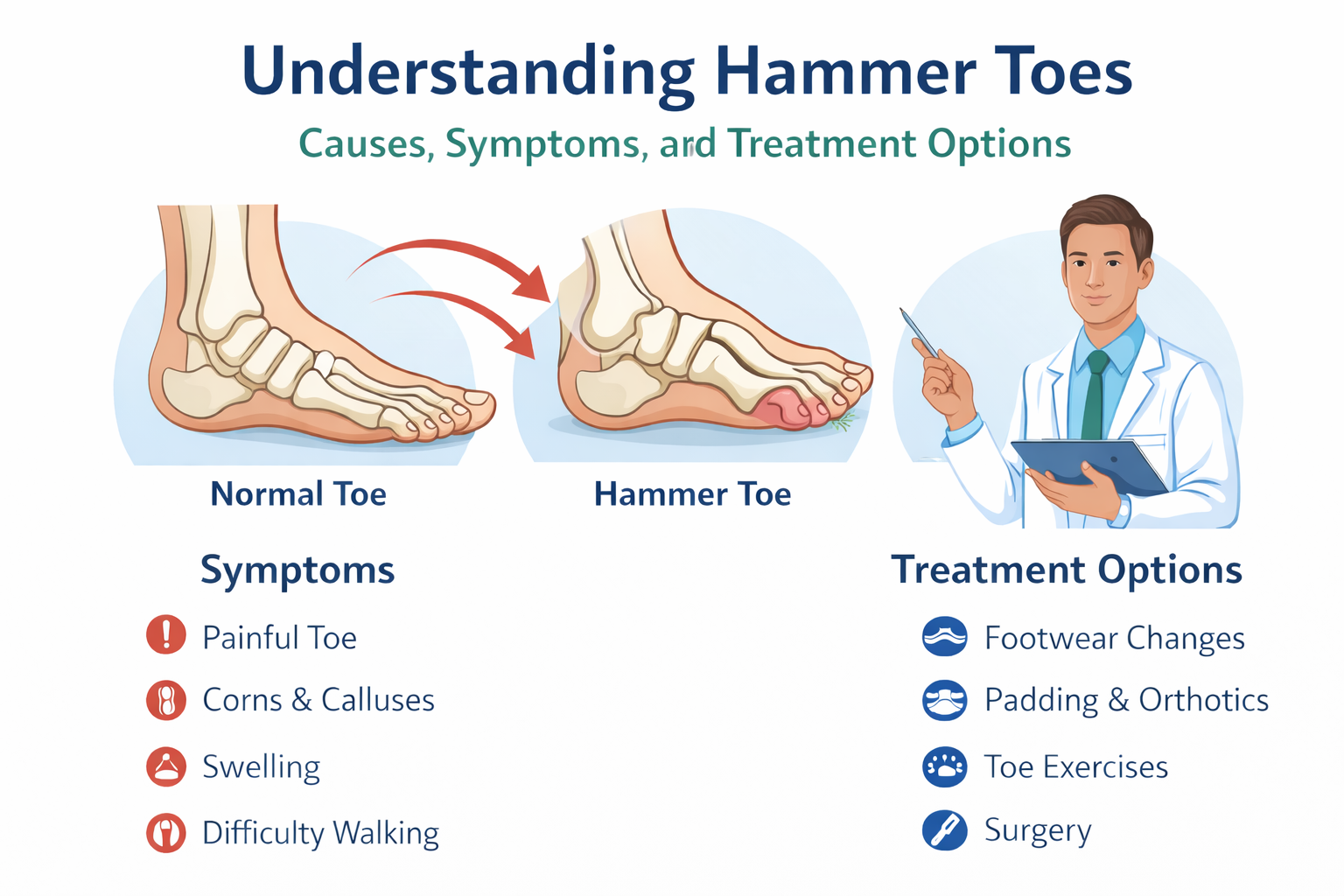

Understanding Hammer Toes: Causes, Symptoms, and Treatment Options
Hammer toes are a common toe deformity that can cause pain, discomfort, and mobility issues. The condition occurs when one or more toes become permanently bent at the middle joint, creating a hammer-like appearance. Hammer toes can affect adults of all ages, particularly those who wear tight or high-heeled shoes, have underlying foot conditions, or experience muscle imbalances.
At Nationwide Foot & Ankle Care, P.C., our expert podiatrists in Livonia and Royal Oak, MI specialize in diagnosing and treating hammer toes. We provide comprehensive care, from early conservative management to advanced surgical interventions, helping patients relieve pain, restore mobility, and prevent long-term complications.

Anatomy & Function: How Toes Work and What Happens in Hammer Toe
A normal toe relies on bones, joints, tendons, and muscles to provide flexibility and support for walking, balance, and weight distribution. Each toe has multiple joints that allow movement, while the surrounding muscles and tendons help lift, straighten, and stabilize the toes during daily activities.
In hammer toes, an imbalance in these muscles and tendons causes the middle joint to bend downward. This abnormal bending disrupts normal biomechanics, creating pressure on the joint and rubbing against footwear. Over time, this can lead to pain, corns, calluses, and limited toe mobility. Understanding the anatomy of the toe helps patients see why early intervention is so important for both comfort and long-term foot health.
Who Is at Risk for Hammer Toes?
Hammer toes can affect anyone, but certain groups are at higher risk. Identifying risk factors allows patients to take preventive measures:
- Age & Gender: Older adults are more commonly affected, and women are at higher risk due to footwear choices such as high heels.
- Footwear: Tight, narrow, or high-heeled shoes that force toes into a bent position.
- Lifestyle & Activity Level: Athletes, dancers, or people who spend long periods standing or walking.
- Medical Conditions: Arthritis, diabetes, neuromuscular disorders, or prior foot injuries.
- Genetics: Family history of toe deformities or foot structure abnormalities such as high arches or flat feet.
Recognizing these risk factors early can help patients make lifestyle or footwear adjustments that may prevent progression.
Early Signs vs. Advanced Cases
Hammer toes progress gradually, and symptoms vary depending on severity. Understanding early signs allows for timely intervention:
- Mild (Flexible): Slight bending at the middle joint, occasional discomfort in shoes, and the toe can still be manually straightened.
- Moderate: Persistent bending, pain when walking or wearing shoes, and corns or calluses forming on the top or tip of the toe.
- Severe (Rigid): Permanent bending, difficulty walking, visible deformity, and chronic pain. Conservative treatments may no longer be effective, and surgical correction is often needed.
Patients should monitor any toe discomfort or deformity and seek evaluation promptly to avoid progression.
Complications of Untreated Hammer Toes
If left untreated, hammer toes can lead to secondary problems that affect mobility and quality of life. Common complications include:
- Corns and Calluses: Friction from footwear leads to painful thickened skin.
- Ulcers or Skin Breakdown: Particularly concerning for diabetic patients or those with poor circulation.
- Joint Stiffness: Loss of mobility in the affected toe joint.
- Altered Gait: Changes in walking patterns can strain knees, hips, and back.
- Persistent Pain: Difficulty walking, exercising, or wearing shoes comfortably.
Early evaluation by a podiatrist can prevent these complications and preserve foot health.
Symptoms of Hammer Toes
Hammer toes develop gradually, and symptoms can vary depending on severity. Recognizing these signs early can improve outcomes and treatment success.
Patients may first notice mild discomfort when wearing shoes or a subtle change in toe alignment. As the condition progresses, additional symptoms can appear:
- Visible Toe Deformity: The middle joint bends downward, giving the toe a hammer-like appearance.
- Pain or Discomfort: Pain is often worse when wearing shoes, walking, or during physical activity.
- Swelling and Redness: Inflammation may develop due to friction against footwear.
- Corns or Calluses: Thickened skin forms on top or at the tip of the toe, causing irritation.
- Difficulty Walking: Severe or rigid hammer toes can interfere with balance and mobility.
If you notice any of these symptoms, consulting a podiatrist promptly is essential. Early evaluation increases the success of conservative treatment and may prevent surgery.
Diagnosis Process
A thorough evaluation is essential to develop a tailored treatment plan. At Nationwide Foot & Ankle Care, P.C., our podiatrists assess patients using multiple diagnostic methods:
- Physical Examination: Evaluates toe alignment, flexibility, and pain points.
- X-Rays: Identify joint changes, bone alignment, and severity of the deformity.
- Gait Analysis: Measures how hammer toes affect walking patterns and balance.
- Biomechanical Assessment: Determines underlying causes, such as tendon imbalances or structural abnormalities.
After a comprehensive diagnosis, podiatrists create personalized treatment plans to address the patient’s unique needs.
Causes of Hammer Toes
Hammer toes arise from a combination of factors:
- Improper Footwear: Shoes that are too tight, narrow, or high-heeled push toes into a bent position.
- Muscle Imbalances: Weak or overactive tendons and muscles cause abnormal forces.
- Injury or Trauma: Stubbed toes, fractures, or repeated injuries may trigger deformity.
- Medical Conditions: Arthritis, diabetes, and neuromuscular disorders can weaken joint support.
- Genetics: Certain foot structures and family history play a role.
Understanding these causes helps patients take preventive measures and address modifiable risks.
Treatment Options
Treatment depends on severity, flexibility, and overall foot health. Proper treatment can relieve pain, restore function, and prevent recurrence.
Non-Surgical Treatments
For mild or flexible hammer toes, conservative care is often effective:
- Footwear Adjustments: Wide toe boxes and low heels reduce pressure.
- Padding and Orthotics: Cushions or custom orthotics relieve pain and improve alignment.
- Exercises: Stretching and strengthening routines maintain flexibility and correct muscle imbalance.
- Medications: OTC anti-inflammatory drugs reduce pain and swelling.
These measures are most effective when combined with lifestyle adjustments and early intervention.
Surgical Treatments
Severe or rigid hammer toes may require surgery:
- Tendon Release or Transfer: Adjust tendons to straighten the toe.
- Joint Resection (Arthroplasty): Remove part of the joint to restore alignment.
- Fusion Surgery (Arthrodesis): Permanently fuses the joint to relieve chronic pain.
Post-operative care includes rehabilitation, protective footwear, and gradual return to normal activity.
Preventive Tips
Even after treatment, prevention is key:
- Wear shoes with ample toe room and low heels.
- Avoid prolonged use of narrow or high-heeled shoes.
- Perform regular toe exercises to strengthen and stretch muscles.
- Seek podiatry evaluation at the first sign of discomfort.
Following these preventive measures helps maintain proper toe alignment and avoid future deformities.
Schedule Your Consultation
Experiencing toe pain, visible deformity, or difficulty walking? Contact Nationwide Foot & Ankle Care, P.C. in Livonia or Royal Oak, MI for personalized hammer toe treatment. Relieve pain, restore mobility, and improve quality of life.


Visit us
13407 Farmington Road Suite 102, Livonia, MI 48150